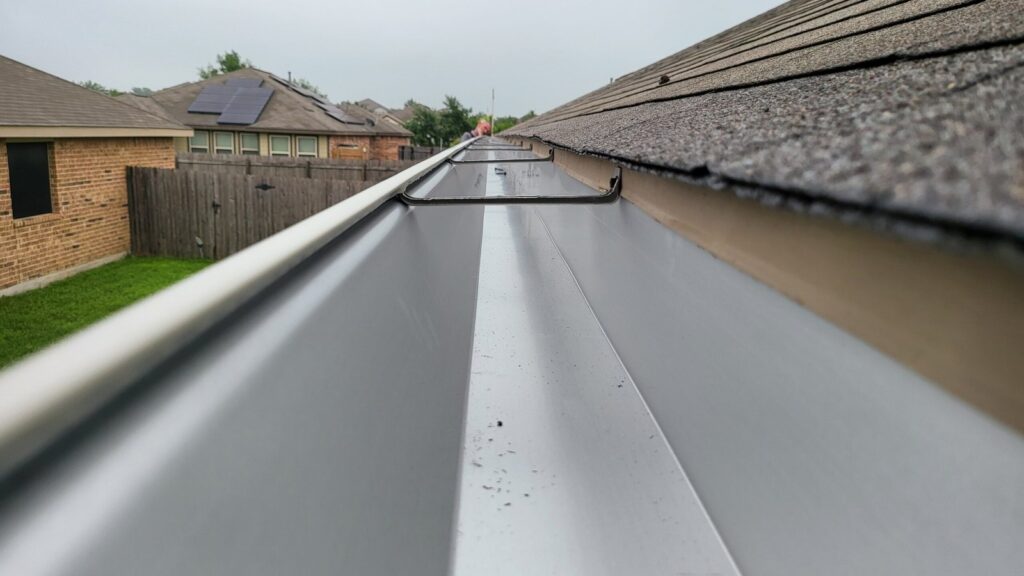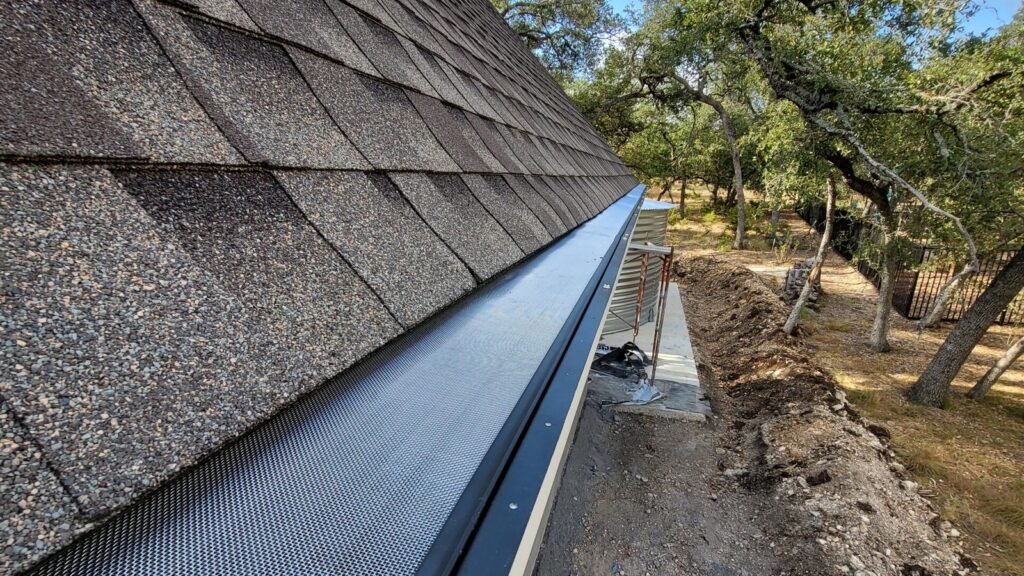
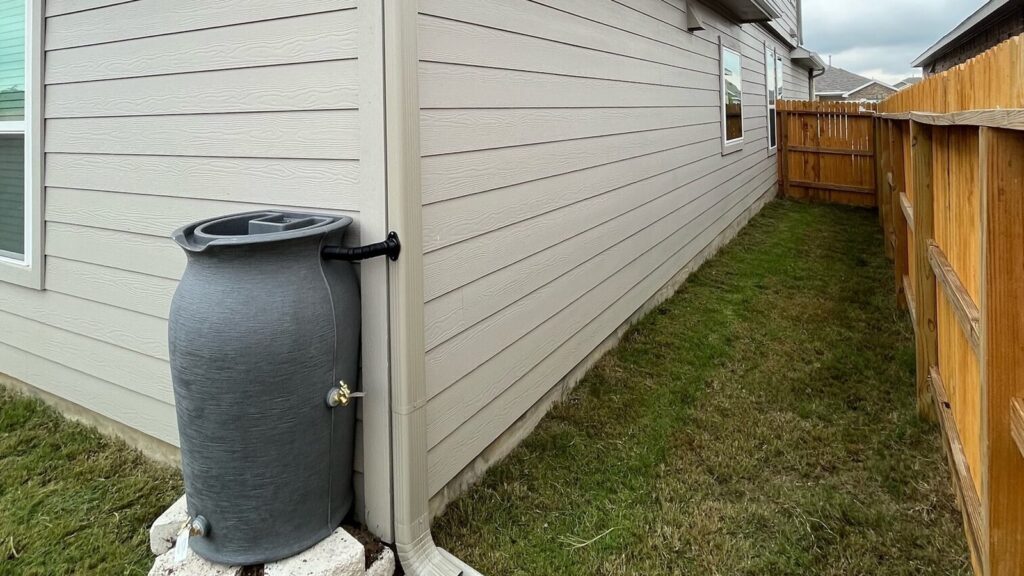
HOA neighborhoods have filled in all around Kyle, Buda, San Marcos and New Braunfels. If you live in one, you’ve probably wondered whether a rain barrel will earn you a letter from the architectural committee. Here’s the answer up front: Texas law is on your side. Your HOA can’t ban a rain barrel outright. It can, however, have a real say in where the barrel sits, what color it is and what it looks like from the street.
Below is what the law says, what your HOA can still regulate, and how to get a barrel approved. We’ll also cover what to do if the committee says no. One note before we start: we install gutters and rain barrels, we aren’t lawyers, and this isn’t legal advice. Read your own HOA documents and the statute itself before you rely on any of it.
Can a Texas HOA ban rain barrels?
No. A Texas HOA can’t prohibit or restrict you from installing a rain barrel or a rainwater harvesting system. The state law is Section 202.007 of the Texas Property Code (Texas Property Code 202.007). It says an association “may not include or enforce a provision” in its governing documents that “prohibits or restricts” an owner from installing rain barrels or rainwater harvesting systems. Any provision that does is void.
That protection has been on the books since 2011. The Legislature added rain barrels to a section that already covered composting, drip irrigation and drought-resistant landscaping. The Texas Water Development Board, the state’s water planning agency, promotes rainwater harvesting too, so the policy direction is clear. If your deed restrictions still say “no rain barrels,” that line is older than the law or ignores it. Either way, it can’t be enforced as a flat ban.
What the law doesn’t do is give you a blank check. The same section lists several things an HOA is still allowed to control, and most disagreements between homeowners and committees come down to those details.
What can your HOA still regulate?
Section 202.007 spells out where an association can draw lines. Under the statute, an HOA does not have to allow a rain barrel or harvesting system in these situations:
- On HOA land or common areas. Property the association owns, or that members own in common, is off limits unless the HOA agrees.
- Between the front of your house and the street. The front yard is the one part of your own lot where the HOA can say no.
- In a color that clashes with your home. The HOA can require a color consistent with your home’s color scheme.
- With printing or graphics on it. A barrel can’t display language or other content that isn’t typically on that barrel as it’s manufactured.
There’s one more power, and it’s the one that shows up in design guidelines most often. For a barrel on the side of the house, or anywhere visible from a street, another lot or a common area, the HOA can regulate size, type, shielding and materials. Shielding usually means screening it with a fence panel, lattice or plants.
There’s a guardrail on that power. Those rules can’t prohibit the “economic installation” of a barrel. They also assume there’s a reasonably sufficient area on your lot to put one. In plain terms, an HOA can ask you to screen a barrel or pick a smaller one for a visible spot. It can’t write rules so strict that no reasonable barrel fits anywhere on your property.
Where can a barrel go on a typical Kyle or Buda lot?
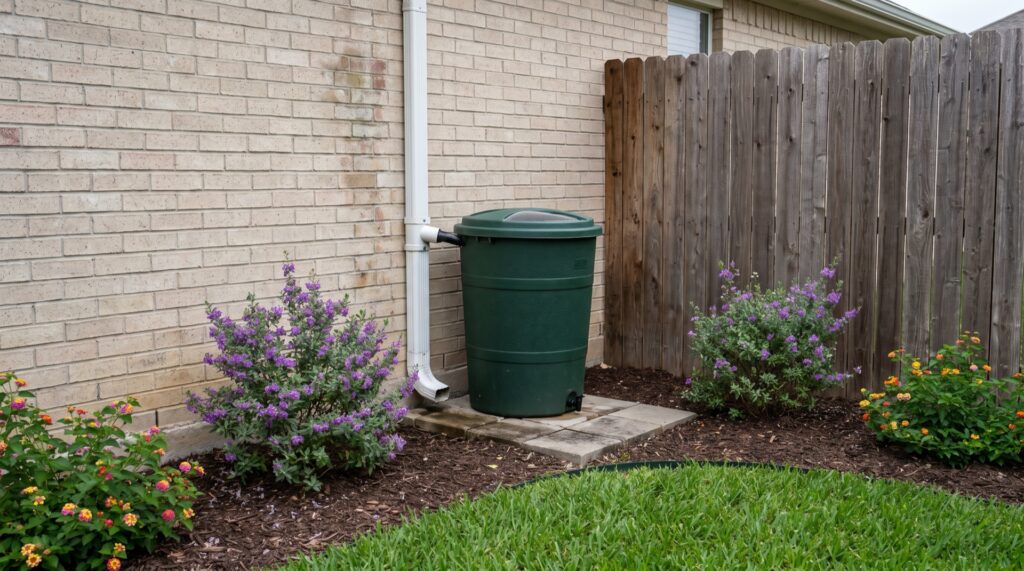
On most suburban lots in Hays County, the easy answer is a back corner or a side yard behind the fence line. That keeps the barrel out of the front-yard zone the HOA can restrict. It usually hides it from the street too, which takes most shielding and size questions off the table.
The catch is that your downspouts weren’t placed with a rain barrel in mind. Builders tend to drop downspouts wherever the gutter run ends, which on many homes means right next to the garage or the front porch. That’s where a little gutter work makes the HOA conversation simpler. We can move a downspout, add one at a back corner, or run a short section of gutter so the water lands where the barrel can sit quietly out of sight. You can see the rain barrel and collection tank setups we install, from a single side-fed barrel to a larger tank fed by several downspouts.
If the only good downspout is visible from the street, that’s still allowed. Plan on a barrel in a muted color that matches the house, a lid or screen, and some kind of shielding, because that’s exactly the spot the statute lets an HOA regulate.
How to get a rain barrel approved by your HOA
Many HOAs require an application for any exterior change, even one the law protects. Submitting one is usually faster than arguing about whether you needed to. Here’s the process that tends to go smoothly:
- Read your design guidelines first. Look for a section on rain barrels, water conservation or “appurtenances.” Some guidelines written after 2011 already list approved colors and screening rules.
- Pick the spot and the barrel to match. Side or back yard if you can. Choose a color close to your trim or brick, with no printing on it.
- Put it on paper. Include a photo of the location, a simple sketch showing the barrel and downspout, the barrel’s size and color, and how it will be screened.
- Show where the overflow goes. Committees like to see that extra water is carried away from the slab and the neighbor’s yard, not dumped beside the house.
- Cite the statute politely. A one-line reference to Property Code 202.007 in the application sets the tone without starting a fight.
- Keep copies of everything. Save the application, the approval and any emails in one folder.
Approval is also about neighbors. A barrel with a tight lid and a screened inlet doesn’t hold open water, so it won’t become the mosquito source next door. Our post on why open water in a barrel or gutter breeds mosquitoes explains why a sealed setup matters in a Central Texas summer.
If the architectural committee says no
A denial isn’t the end of it. In an HOA with more than 40 lots, once the developer no longer controls the committee, Texas Property Code 209.00505 gives you a defined appeal. The denial has to come in writing, explain the reason in reasonable detail and list any changes that would get the project approved (Texas Property Code 209.00505).
From there, you have 30 days to request a hearing with the HOA board. The board must hold that hearing within 30 days of your request and give you at least 10 days’ notice. Both sides can discuss the facts, either side can record the meeting, and the board can affirm, change or reverse the committee’s decision.
Often the denial letter itself points to the fix. If it says the barrel is visible from the street and needs screening, adding a lattice panel and resubmitting is quicker than a hearing. If the denial amounts to “no rain barrels, period,” the hearing is the place to point out that a flat ban is void under 202.007.
What if the HOA skips the paperwork and sends a violation notice? Under Section 209.006, the association generally has to warn you before it can fine you. That means a certified-mail notice describing the violation and, if it’s curable, a reasonable period to fix it. Not building something to approved plans counts as curable, so you’ll usually have a chance to adjust the setup before any fine.
The exemption and the rules that still apply
Section 202.007 has one narrow exemption, and it takes two conditions. The association has to sit in a city of more than 175,000 people, in a county mostly taken up by a city of over a million. It also has to manage a development with at least 4,000 acres set aside for commercial use, apartments or open space. That fits only a few very large master-planned communities. Most HOAs in our part of Central Texas are covered by the rule, but a quick check is worth it if you live in a huge planned community.
A few things sit outside HOA rules entirely. A large tank may need to meet local city rules for structures, pads or setbacks, so check before you pour a slab for one. Utility rebates come with their own program requirements, and your community’s water utility may set its own watering rules for stored rain. Texas also exempts rainwater harvesting equipment from state sales tax, and some local taxing units offer property tax relief. Our post on tax breaks and other Texas rainwater laws covers those details so we won’t repeat them here.
Planning the gutters and downspouts around HOA rules
The barrel is the part the HOA sees, but the gutters decide whether it works. A barrel can only collect what your gutters deliver, and on a typical roof a single downspout often drains only a quarter or a third of the house. Put the barrel on a downspout that drains a decent share of roof, and it fills in the first few minutes of a real storm. If you want more storage than a barrel holds, our guide on how to size a collection tank to your roof works through the math.
Looks matter to committees too, and that’s where seamless gutters help. Each straight run is formed on site, so there are no seam lines to drip near the barrel, and downspouts can be ordered in a color that matches your trim. A matched downspout feeding a matched barrel reads as part of the house, not an add-on.
Gutters Made Easy is a family-owned company based in Kyle, and we handle the whole path, from the roof edge to the barrel inlet and the overflow. Has your HOA asked for a plan? Want help picking a spot that meets the guidelines? We can measure your roof and quote a rain barrel or collection tank that fits your HOA’s rules, with the downspout work included. And again, for any legal question about your specific HOA, read your dedicatory instruments and talk to a Texas real estate attorney.