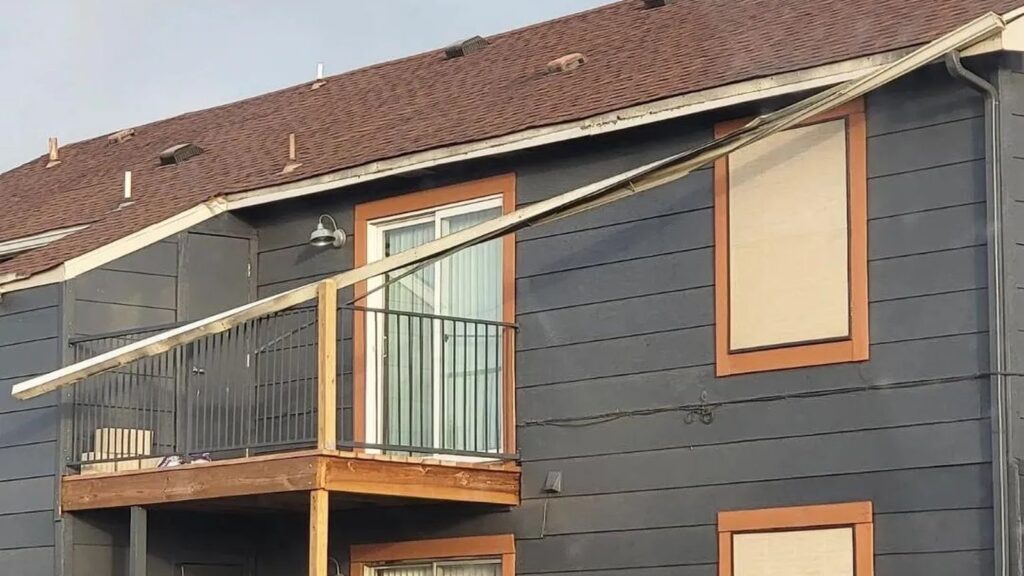
Most lists of “signs you need new gutters” read the same: rust, cracks, sagging, clogs, water damage. They’re not wrong. The trouble is that a repair can also fix every one of those signs, and plenty of Central Texas homeowners replace a whole gutter system when a targeted repair would have bought them years.
The opposite happens too. Someone reseals the same leaky corners every spring for a decade, never noticing that the fascia behind the gutter has gone soft. So which one does your home need? This post walks through the difference, using the same things we look at on a Hays County roofline before we recommend either one.
How do you know whether to repair or replace your gutters?
Repair when the problems are isolated. Replace when they’re everywhere. A few leaking joints, one sagging run or a crushed downspout is a repair. Leaks at most joints on an old sectional system, steel that has rusted through, rotted fascia along much of the eave, or gutters that were undersized for the roof from the start usually make replacement the better use of your money.
Age matters less than people think. InterNACHI’s life expectancy chart puts aluminum gutters at 20 to 40+ years, and that’s a wide range for a reason. A 20 year old aluminum system that has been kept clean and properly pitched can have a lot of life left. A 12 year old system hung without enough fall, with hangers spaced too far apart, can already be finished. The right question isn’t “how old is it?” but “how many places is it failing, and is the wood behind it still sound?”
When a gutter repair is enough
A gutter is a simple thing. It’s a trough, a set of hangers, a few joints and some downspouts. When one of those parts fails and the rest is sound, fixing that part is almost always the smart move.
Good candidates for a repair include a corner or end cap that drips, a run that pulled loose because a few hangers backed out, a downspout elbow that got crushed by a mower, or a section that holds water because it lost its fall. Heat is often the culprit on joints. Sealant at seams and end caps dries out in a Texas summer, and we’ve written about how summer heat cracks seam sealant long before the metal itself wears out.
If that’s what you’re seeing, repairing a leaking or sagging gutter run on solid fascia is usually all it takes. The key is fixing the cause, like re-hanging a run on proper spacing, not just smearing more sealant on the drip.
Five signs it’s time to replace your gutters
Each of these can show up in a single spot, which is a repair. When they show up across the house, or keep coming back after repairs, replacement starts to make more sense.
Rust and corrosion
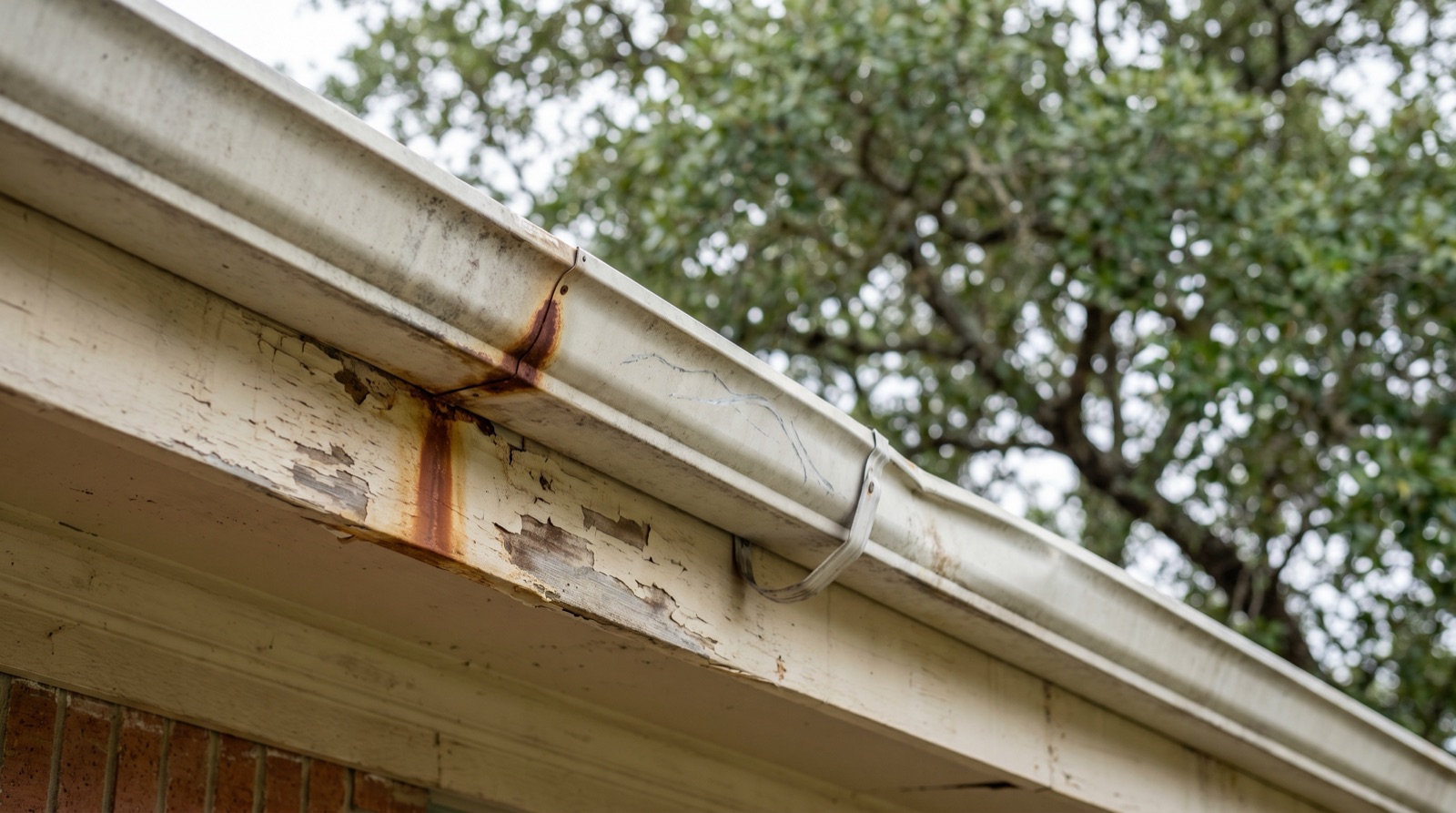
Galvanized steel gutters usually start rusting inside the trough, where water and debris sit longest. InterNACHI gives galvanized steel gutters an expected life of about 20 years. A crew can clean and coat surface rust. Rust you can push a screwdriver through, or rust spread along the bottom of long runs, means the metal is done. Aluminum doesn’t rust, but it can corrode where it touches dissimilar metal fasteners. Copper gutters are the long-haul exception; when an old copper system has problems, it usually needs new hangers or joints, not a new trough.
Cracks, holes and split seams
A patch handles small holes from a fallen limb or a ladder. Splits along the bottom of a run or cracks spreading from many joints are a different story. On sectional gutters, every joint is a seam that has to stay sealed through thousands of hot and cold cycles. Aluminum expands about 23 millionths of its length per degree Celsius (Engineering ToolBox), so by our arithmetic a 40 foot run changes length by roughly 0.6 inch across a 100 degree Fahrenheit swing in metal temperature, the kind of swing a sunny roof edge sees between a winter night and a summer afternoon. Joints take that movement over and over, which is why seams fail first.
Sagging and pulling away
A single sagging run usually means loose or missing hangers, and that’s a straightforward repair. Sagging along most of the house, or gutters pulling away with the fascia board still attached to the fasteners, points to rotted wood or a system that was never hung right. Re-hanging gutters onto rotten fascia only buys a season.
Clogs and overflow that keep coming back
If the gutters overflow in every hard rain even when they’re clean, the problem may be capacity, not debris. Too few downspouts, downspouts too small, or a gutter size that can’t keep up with the roof area all show up as overflow. That’s a design problem. Cleaning won’t fix it, and repairs usually can’t either.
Water damage, rot and mold
Peeling paint on the fascia, stains on the siding below the gutter line, soft wood at the roof edge, or mildew on the eaves all mean water is getting where it shouldn’t. Sometimes the cause is one bad joint. Often it’s water running behind the gutter along the whole eave, which takes a full fix at the roof edge.
How long do gutters last in Central Texas?
Here’s what InterNACHI’s Standard Estimated Life Expectancy Chart lists for common gutter materials. The chart says these figures assume regular maintenance and normal wear, not extreme weather or neglect, and should be used as guidelines only.
| Material | InterNACHI estimate | What shortens it here |
|---|---|---|
| Aluminum | 20 to 40+ years | Hail dents, poor pitch, failing joints on sectional runs |
| Galvanized steel | About 20 years | Standing water and wet debris that start rust from inside |
| Vinyl | 25+ years | Summer sun and heat that make plastic brittle |
| Copper | 50+ years | Rarely the gutter itself; usually hangers or joints |
The wide range on aluminum is the point. Whether your system lands near 20 years or well past 40 depends on how the crew installed it and how you’ve kept it up. That’s why we look at condition first and age second.
What heat, hail and clay soil do to an aging gutter system
Central Texas is hard on a roof edge. The National Weather Service office for Austin and San Antonio found that the annual number of 100 degree days at Austin’s Camp Mabry rose by 11 days between the 1981 to 2010 normals and the 1991 to 2020 normals, and that heavy rain days increased at the same time (NWS Austin/San Antonio). More heat bakes sealant faster. Heavier rain finds every weak joint.
Hail is the other big one. According to the Insurance Information Institute, using NOAA Storm Prediction Center data, Texas had 902 major hail events in 2025, more than any other state. Still draining after a hailstorm? Dented gutters often do, but deep dents can hold water and throw off the pitch. Hail damage is a sudden event, which is different from wear and tear in the eyes of an insurer. The Texas Department of Insurance lists wear and tear among the things most homeowners policies don’t cover, so it’s worth calling your agent after a storm rather than waiting until the gutters fail on their own.
Then there’s the ground. Many neighborhoods east of I-35 sit on blackland clay that swells when wet and shrinks when dry. A gutter system that dumps water at the slab, or overflows along one side of the house, keeps that soil cycling. When a system can’t get water away from the foundation without constant fixes, replacing it with properly sized gutters and downspouts is often the real repair.
Check the fascia before you decide
The wood behind the gutter often decides the question for you. Fascia is the board along the edge of the roof that your gutters hang from. Older sectional gutters that leak at every joint tend to rot it from behind, out of sight, for years.
If the fascia is sound, a repair has something solid to hold onto. If it’s soft along long stretches, the gutters have to come down to fix it anyway, and that’s the natural point for a gutter replacement with new seamless gutters. You can learn the signs of fascia water damage from the ground with a pair of binoculars and a screwdriver test along any boards you can reach safely.
If you are weighing a new system, the differences between seamless and sectional gutters are worth a look before you choose. A seamless run formed on site to the length of each eave has joints only at the corners and downspouts, which removes most of the places an old sectional system leaks.
What we look at before recommending a repair or a replacement
Tyler Smith has spent more than twenty years hanging and fixing gutters across Central Texas. When he or our crew looks at a system, we check the same handful of things every time: how many joints are leaking or patched, how the hangers are spaced and fastened, whether each run still has its fall, whether the downspouts can carry what the roof sheds, and how the fascia feels behind it all.
We repair every type of gutter, whether or not we installed it, so there’s no reason for us to push a replacement you don’t need. If the system is sound, you’ll hear that. If it isn’t, we’ll show you why. New seamless gutters from Gutters Made Easy are formed on site and backed by a lifetime manufacturer materials warranty plus our 10-year workmanship guarantee, and financing is available.
If you’re in Kyle, Buda, San Marcos or anywhere else we serve and you’re not sure which way to go, schedule a repair visit or an honest second opinion. Call (512) 881-9204 and we’ll take a look.