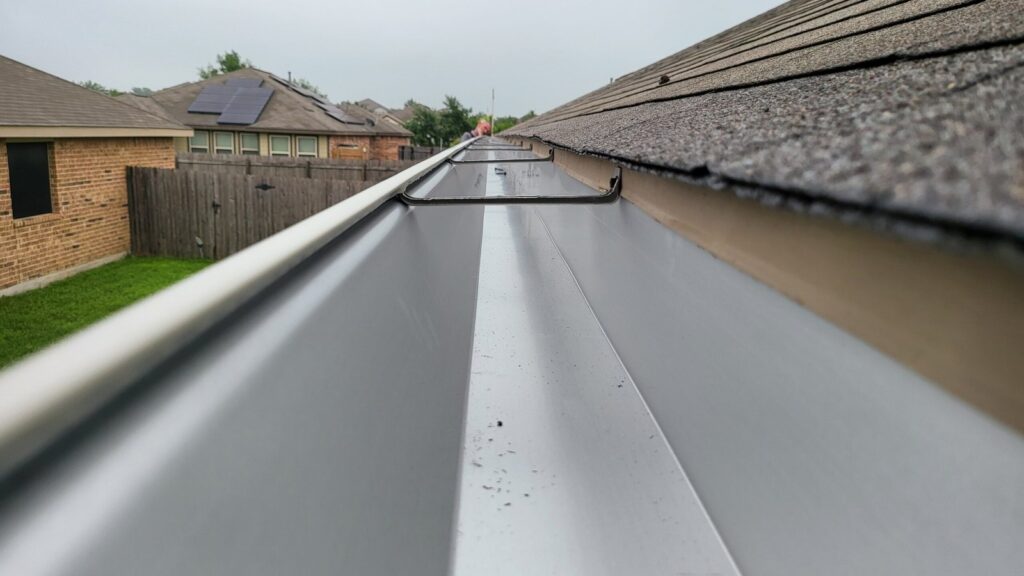
Most homes in Kyle, Buda and San Marcos are built with 5-inch K-style gutters, and on a simple single-story roof that’s usually enough. The trouble starts on big roof planes, steep pitches and valleys, where a Central Texas downpour can put more water into one gutter run than a 5-inch trough can carry. That’s when 6-inch gutters earn their place.
The good news is you don’t have to guess. Gutter sizing comes down to two numbers you can actually look up: how hard it rains where you live, and how much roof drains into each run. Here’s how those two numbers play out on a Central Texas house, and why the right answer is often “5-inch here, 6-inch there.”
Do you need 5-inch or 6-inch gutters for heavy Texas rain?
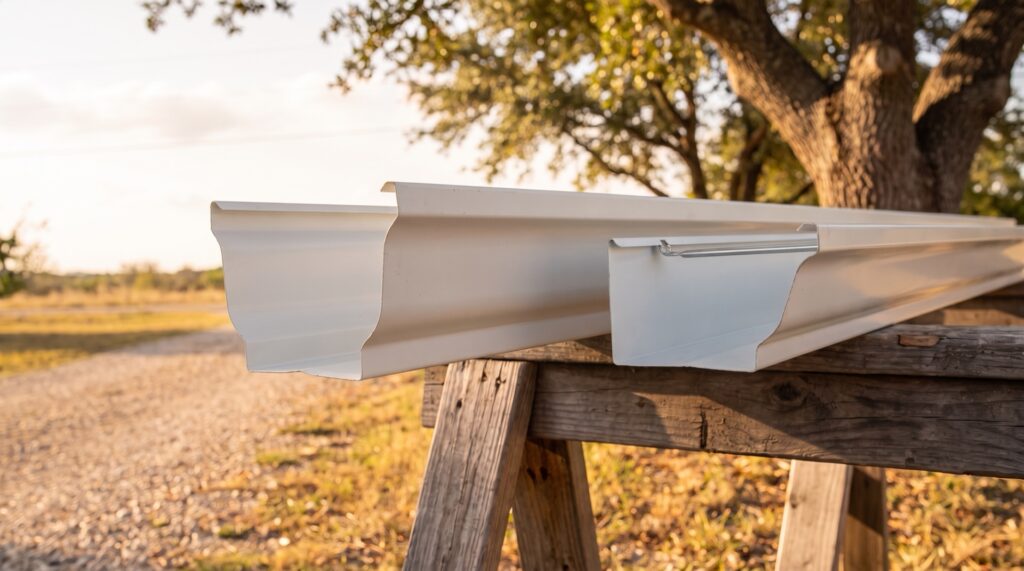
For heavy rain in Texas, the right gutter size is set run by run, not for the whole house. A 5-inch K-style gutter handles most single-story roofs with modest pitch. A 6-inch gutter is the better choice for runs that drain a large roof plane, a steep roof, a valley, a metal roof or a second story. On many homes the right system mixes both sizes.
Why not just put larger gutters on everything? You can, and some homeowners do. But a 6-inch trough is taller and wider, so on a low single-story fascia it can look heavy, and the cost runs a bit higher per foot. If a run only drains a small porch roof, the bigger gutter buys you nothing. The goal is enough capacity where the water actually lands, and a clean look everywhere else.
How much more water does a 6-inch gutter carry?
The plumbing code gives a straight answer. In the International Plumbing Code’s gutter sizing table, a 6-inch gutter at the same slope and rainfall rate serves about 54 percent more roof area than a 5-inch gutter (IPC Table 1106.6). Here’s what that looks like at two rainfall rates on a gentle 1/16-inch-per-foot slope.
| Rainfall rate | 5-inch gutter | 6-inch gutter |
|---|---|---|
| 4 inches per hour | 625 sq ft of roof | 960 sq ft of roof |
| 5 inches per hour | 500 sq ft of roof | 768 sq ft of roof |
Two things to know about those numbers. First, the roof area is the flat footprint that drains into that one gutter run, measured from above, not the sloped shingle surface. Second, the code table is written for half-round gutters. A K-style trough has a deeper, squarer shape than a half-round of the same width, so for K-style the table reads on the safe side. Treat it as a floor, not a ceiling.
Capacity is the whole point. When a run is undersized, the overflow lands right at the base of the wall, soaks the clay next to the slab and splashes mud up the siding. Over a few years of storms, that’s how water damage starts at fascia boards, flower beds and foundations, even on a house where the gutters are clean.
Slope helps a little too. Doubling the pitch of the gutter itself to 1/8 inch per foot raises those figures, but you can only tilt a gutter so far before it looks crooked on the fascia. Size does the heavy lifting.
Why our storms change the math
National sizing advice is often written for places where rain falls more gently. Ours doesn’t. According to NOAA’s Atlas 14 rainfall data for Kyle, a 100-year storm can drop 4.72 inches of rain in a single hour, and a 10-year storm can hit 2.97 inches in an hour (NOAA Precipitation Frequency Data Server). For comparison, the same 100-year, one-hour figure for Chicago is 3.08 inches. That makes our worst hour of rain roughly half again as heavy.
That 100-year hourly rate is the same yardstick the plumbing code uses to size gutters and roof drains. Plug Kyle’s 4.72 inches per hour into the table above and a single 5-inch run tops out somewhere near 500 to 530 square feet of roof. A 6-inch run handles closer to 800. That’s the difference between a back porch and the whole back half of a ranch house.
The short bursts are even sharper. NOAA’s data puts a 10-year, five-minute burst in Kyle at a rate of about 9.5 inches per hour. Those bursts are what you see when water suddenly sheets over the front of a gutter for a minute and then stops. If you want the story behind those storms, our post on why September storms overwhelm undersized gutters covers the Gulf moisture that drives them. Here we’re sticking to the spec.
Roof size, pitch and valleys decide it run by run
The question isn’t “how big is my house.” It’s how much roof drains into each gutter run. A 2,400-square-foot house might split its roof into six or eight runs, and they won’t all carry the same load. Walk around the house and look for these situations:
- Big uninterrupted roof planes. A long back slope on a ranch house can send 600 to 800 square feet of roof into one gutter.
- Valleys. Where two roof slopes meet, the valley funnels water to one short stretch of gutter, often enough to overshoot the front edge in a hard rain.
- Steep pitch. Water picks up speed on a steep roof and can jump a narrow gutter instead of dropping into it.
- Metal roofs and upper stories. A smooth metal roof sheds water fast, and a second-story roof that dumps onto a lower roof doubles the load on the gutter below.
On those runs, a 6-inch trough makes sense. On a front porch or a short side run, 5-inch is fine and looks trimmer. Because our crew forms seamless rain gutters we fabricate on site, we can cut each run to its own size and length right in your driveway instead of choosing one stock size for the whole house.
Downspouts matter as much as the trough
A bigger gutter only helps if the water can get out of it. Here’s the part most sizing guides skip: the downspout is often the real bottleneck. A 5-inch system usually pairs with 2×3-inch downspouts, while a 6-inch system pairs with larger 3×4-inch downspouts that drain faster and are harder to clog with oak leaves and cedar debris. In our experience, larger downspouts are one of the cheapest capacity upgrades on a house.
Adding a downspout can do as much as upsizing the gutter. A long run with one outlet at the far end makes water travel the whole length before it can leave. Put a second outlet near the middle or right below a valley and the same 5-inch trough suddenly keeps up. Our guide to where downspouts go and how many a run needs walks through placement in more detail.
So when a run overflows, the fix might be a bigger gutter, a bigger downspout, an extra downspout, or all three. Watching the house in a hard rain usually tells you which.
When 5-inch is plenty
A 5-inch gutter is still the right call on a lot of Central Texas homes. If you have a single-story house with a modest pitch, no big valleys and runs that each drain a few hundred square feet of roof, 5-inch with well-placed downspouts will handle our storms. It’s also a little less expensive per foot and sits lower on the fascia.
Going to 6-inch has a few trade-offs worth knowing before you decide:
- Looks. On a short, low fascia board, a 6-inch trough can look oversized. On a two-story house or a home with a wide fascia, it usually looks right at home.
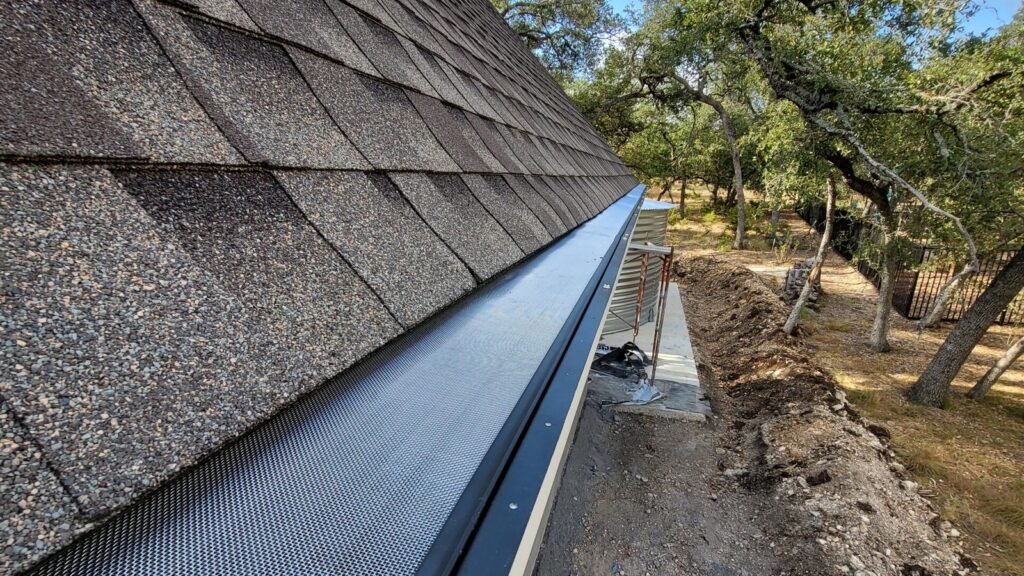
- Gutter guards. Guards are sized to the gutter. A 5-inch guard won’t fit a 6-inch trough, so plan the guard and the gutter together.
- Weight. A full 6-inch gutter holds more water, so hangers need solid fascia wood and the right spacing.
- Maintenance. Cleaning and upkeep are about the same for both sizes. A wider trough is a little easier to scoop by hand, and the bigger downspouts clog less often.
None of those are reasons to avoid 6-inch where you need it. They’re reasons not to use it where you don’t.
How we size a system on your roof
When we look at a home, we don’t start with a stock answer. Owner Tyler Smith has more than 20 years in rain gutters and sheet metal, and the walk-around covers roof area per run, pitch, valleys, the roofing material and where each downspout can safely send its water. Then we fabricate every run on site so a 6-inch section fits the back of the house and a 5-inch run trims out the front porch if that’s what the roof calls for.
Every system is backed by a lifetime manufacturer warranty on materials and a 10-year guarantee on our workmanship. If your gutters spill over in every hard rain, or you’re building or re-roofing and want it right the first time, Gutters Made Easy can measure your roof and quote a new seamless gutter system sized for your roof, with no pressure and a straight answer about which runs need the bigger size.