If you’ve started hearing scratching above the ceiling around dusk, or found wood chips on the porch under the eave, there’s a good chance something has found a way in at your roofline. In Central Texas that something is often a fox squirrel or a roof rat. So where are they getting in? More often than people expect, the access point is right behind the gutter.
We’re a gutter and fascia company, not a pest control company, so this post won’t tell you how to trap anything. What we can tell you is where the openings hide, why they show up along the gutter line, and how to repair the wood so the problem doesn’t come back next fall.
How do squirrels get into the attic through the fascia board?
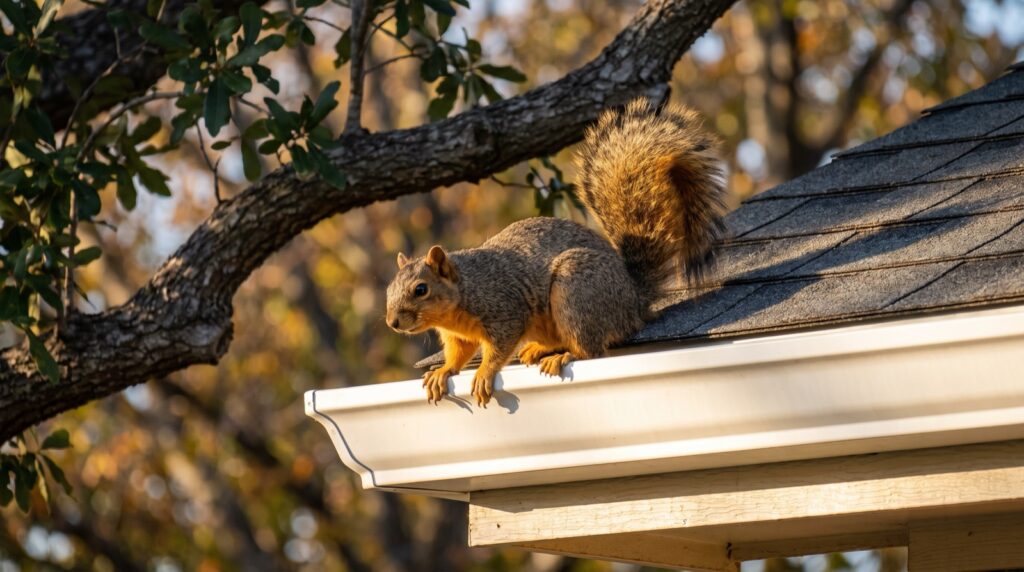
Squirrels chew in where the fascia is already weak. Fascia is the board along the edge of the roof that your gutters hang from. Where that board has gone soft from years of gutter overflow, or where a gap has opened between the fascia and the roof decking, a squirrel can widen it into an entry hole in short order. Texas A&M AgriLife Extension notes that squirrels usually get into attics from the roof, especially where tree limbs overlap the roofline.
Stopping it takes three steps in order: get the animals out, repair or replace the damaged wood, and close the gaps with metal so there’s nothing soft left to chew. Trimming limbs back from the roof keeps them from coming right back. The rest of this post walks through each step and what squirrel damage to a fascia board actually looks like.
Why fall brings squirrels and roof rats to the roofline
Timing has a lot to do with it. According to the AgriLife Extension guide to tree squirrels in Texas, fox squirrels usually have litters in March or April and again in August or September, while gray squirrels often have young in September or October. That puts a lot of squirrels looking for a warm, dry nest site just as the weather turns, and an attic is about as good as it gets.
Their teeth don’t help your house either. AgriLife’s 2025 fox squirrel management guide explains that a squirrel’s incisors grow continuously, up to 6 inches a year, and have to be worn down by gnawing on wood. Fascia, trim and soffit are all within reach from a roof or a branch.
Roof rats add to the problem. University of California pest management guidance describes them as agile climbers that nest in attics and wall voids, and notes that rats can chew through plastic, foam, wood and caulk. Both animals can gnaw on attic wiring, which is why AgriLife and UC both flag a fire risk, not just a nuisance.
Where the gaps hide behind your gutters
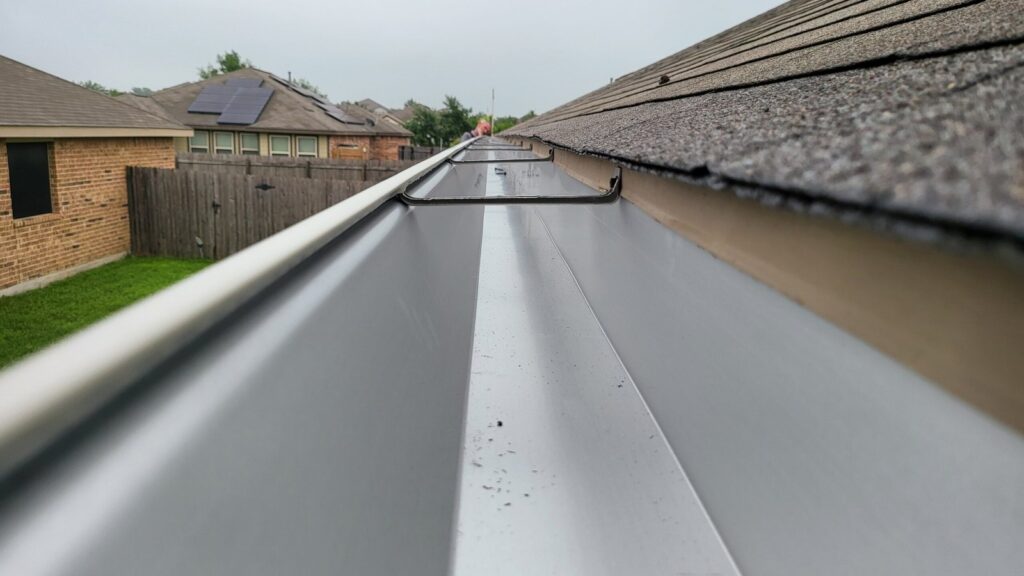
From the ground, a gutter covers most of the fascia. That’s why roofline openings often go unnoticed until something is living in the attic. When our crews take gutters down for a fascia job, these are the spots we check first.
Rotted corners and gutter ends
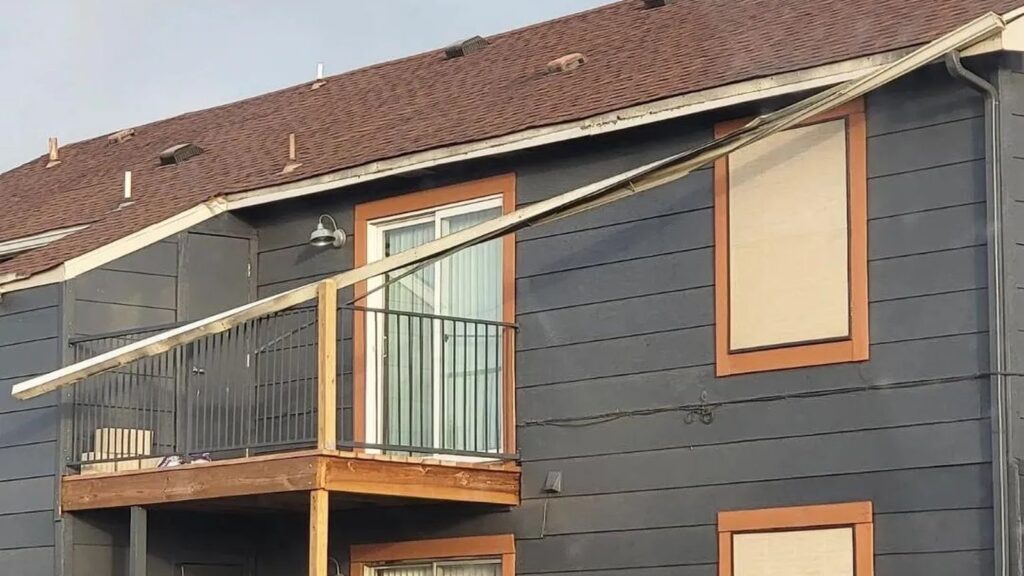
Corners and end caps are where old gutters leak the most, and that water soaks the end grain of the fascia. Soft, punky wood at a corner is easy chewing. A small notch can become a hole within a season.
The seam at the top of the fascia
Look up at the top edge of the fascia, where the roof decking and the drip edge meet it. If the drip edge is short or missing, or the decking has shrunk back, there can be a gap right behind the gutter. It’s out of sight from below, sheltered from weather, and leads straight into the attic. That hidden seam is easy to miss from the ground.
Gable returns and soffit joints
Where the fascia turns a corner into a gable or meets the soffit (the underside of the roof overhang), there are short pieces, joints and trim that loosen over time. Any loose piece is an invitation to pry and chew, and soffits on older homes often have more of those joints than newer construction.
Signs of squirrel damage on a fascia board
You don’t need a ladder to check for most of these. Walk the house with a pair of binoculars on a sunny afternoon and look along the roof edge for:
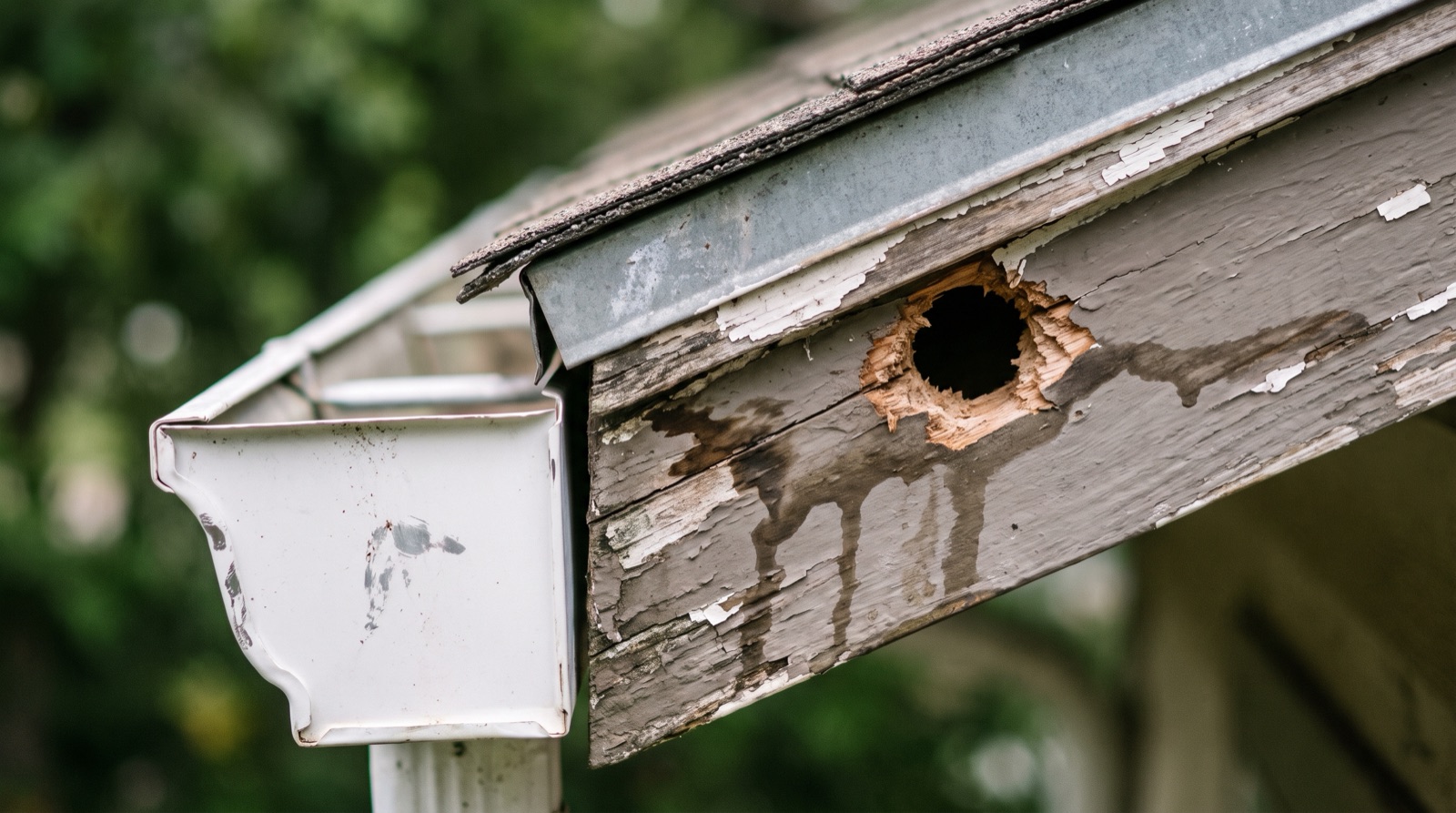
- Fresh, light colored wood showing at corners or along the top of the fascia boards
- Rounded holes with rough, chewed edges
- Wood chips, bits of shingles or nest material on the ground or in the gutter below
- Gutters pulling away at one spot, or a gap you can see sky through behind them
- Scratching or thumping in the attic early in the morning and around dusk
Any one of these is worth a closer look. Two or more together usually means something is already inside.
Get the animals out before anything gets sealed
Do not close up a hole until you know the attic is empty. AgriLife is direct about it: openings should not be sealed until the squirrels are out, and a simple one-way door can let them leave without letting them back in. Sealing young squirrels inside creates a worse problem, and a squirrel locked out of its nest may simply chew a new way in.
This is a job for a licensed wildlife or pest professional. Fox and gray squirrels are classified as game animals in Texas, although AgriLife notes they can be cage-trapped where they are causing damage. Rodent control done for pay falls under the structural pest control licensing run by the Texas Department of Agriculture. A good wildlife pro will confirm what’s in the attic, handle removal, and tell you when it’s clear for the repair crew. That’s the point where we come in.
How to repair squirrel damage at the fascia
Once the animals are out, the repair is mostly carpentry and sheet metal. On a typical Central Texas home, the sequence looks like this:
- Take the gutters down along the damaged stretch so the whole board can be inspected, front and top.
- Replace rotted or chewed wood instead of patching it. Filling a hole in soft wood just moves the chewing over a few inches.
- Close the gaps with metal. AgriLife lists sheet metal, hardware cloth and steel wool as effective materials, and UC guidance says to seal openings larger than 1/4 inch and never use lightweight chicken wire.
- Cover the fascia. Wrapping sound wood in bent aluminum trim leaves no exposed wood edge to start on.
- Rehang the gutters on the solid edge, with proper flashing so water stops reaching the top of the board.
Step four is where most homeowners save themselves the next round. Our crew measures and bends the metal on site to fit the height of each board and the drip edge above it, so the trim fits tight at corners and gable ends. Wrapping the repaired boards in aluminum trim also ends the scrape and repaint cycle on that wood. We always check the board before it gets covered, because wrapping over rotted wood only hides the problem.
Then deal with the highway. AgriLife recommends trimming tree limbs back at least 8 to 10 feet from the roof, and UC suggests keeping limbs at least 3 feet away to discourage roof rats. On oak and pecan lots, that may mean a call to an arborist before the repair crew arrives.
Keeping critters out of the gutter itself
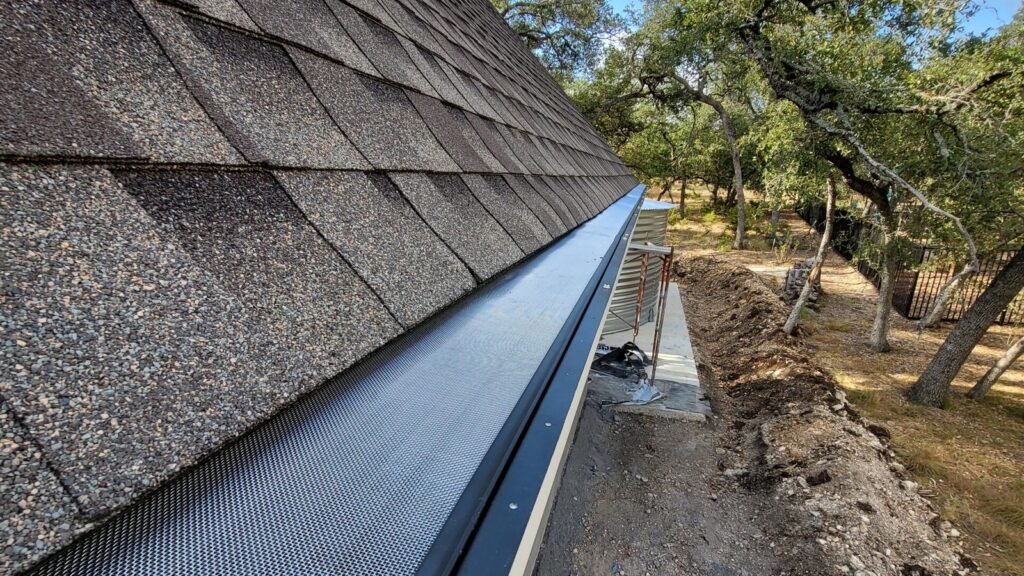
Gutters full of wet leaves and acorns are an easy place for an animal to dig, nest and gnaw at the board behind. Keeping them clean helps, so why give a squirrel a head start? On heavily wooded lots, a stainless micro mesh gutter guard keeps leaves out and also keeps birds, rodents and other critters out of the trough.
It also helps to understand how water damage starts in a fascia board, since rot is usually what turns a squirrel’s curiosity into a hole. Fix the water and you take away the soft spot.
When to call a gutter crew
If a wildlife pro has cleared the attic and you’re looking at chewed corners, soft boards or gaps behind the gutters, that’s our part of the job. Tyler Smith has spent more than twenty years working on Central Texas rooflines, and we’ll show you every damaged board before anything gets covered.
Gutters Made Easy serves Kyle, Buda, San Marcos, Austin, New Braunfels and the surrounding Hill Country. Call (512) 881-9204 or request a fascia repair and wrap estimate, and we’ll plan the repair so the gutters only come down once.