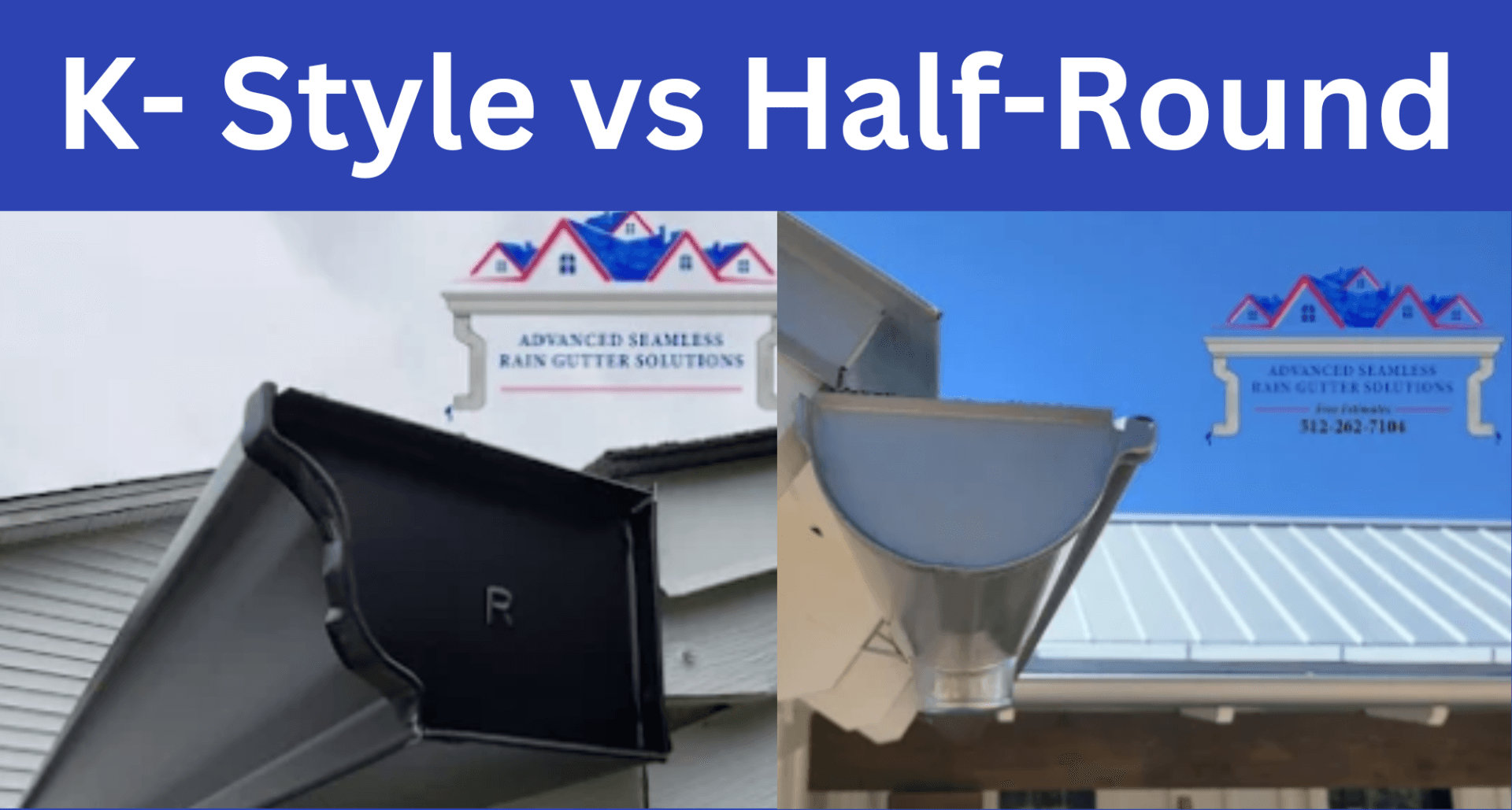
For most Central Texas homes, K-style gutters are the better choice. They carry more water for their size, cost less, and fit the flat fascia boards found on most houses built in the last fifty years. Half-round gutters are the better choice when the look matters most: historic homes, traditional architecture and copper installations, where their classic rounded profile is part of the design.
That’s the short answer. The longer answer depends on how much water your roof sheds, what your house looks like, how many trees hang over it and how much upkeep you’re willing to do. Below we compare K-style and half-round gutters side by side, then cover where box gutters fit into the picture.


What K-style and half-round gutters are
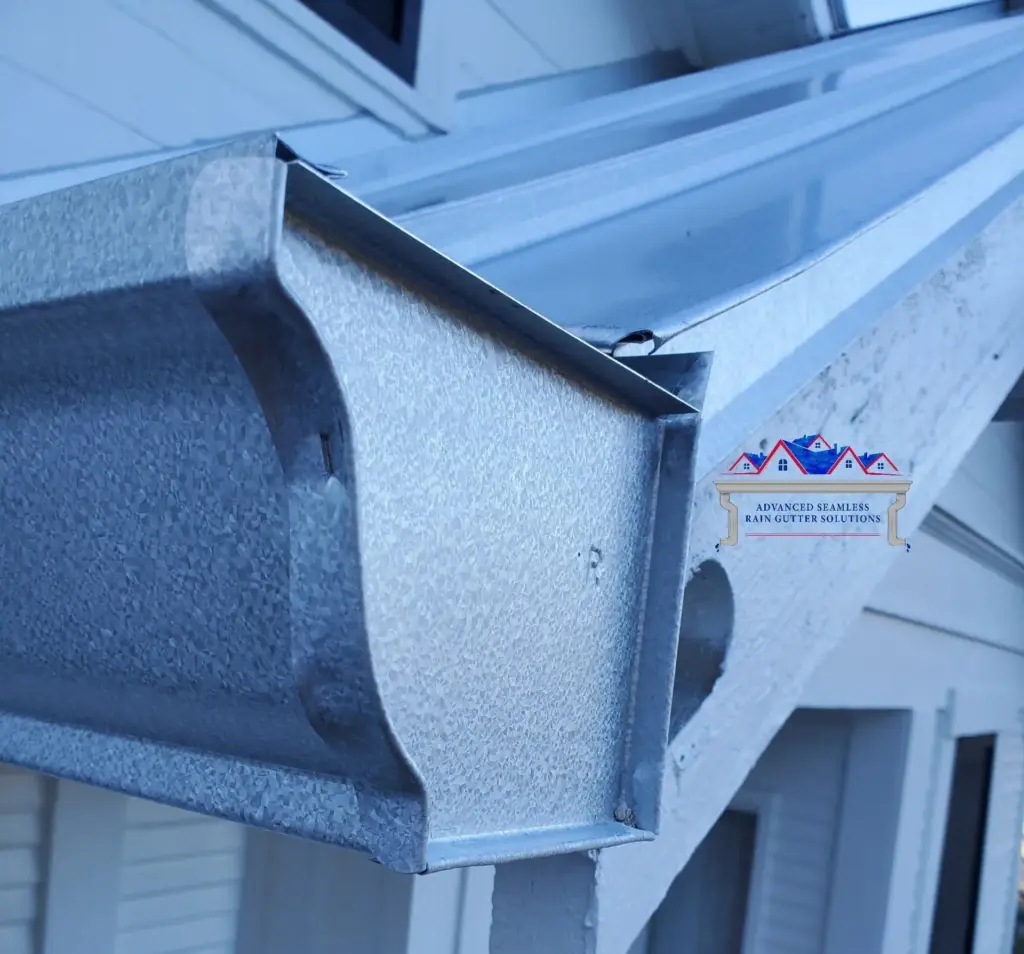
K-style gutters have a flat back and a flat bottom, with a decorative front face shaped like crown molding. Seen from the end, the profile looks a bit like the letter K, which is where the name comes from. The flat back sits tight against the fascia board, so the gutter screws straight on with hidden hangers. K-style is the most popular residential gutter profile, and for homes in our area it usually comes in 5-inch, 6-inch or 7-inch widths, paired with rectangular downspouts.
Half-round gutters are exactly what they sound like: a semicircle, open at the top. Because the back is curved, they hang from brackets or hangers rather than sitting flat against the fascia. They’re typically 6 or 8 inches wide and usually paired with round downspouts, though square downspouts work too. Half-round is the traditional gutter profile, the one you see on older homes, churches and courthouse-square buildings.
Both styles can be fabricated as seamless gutters, cut from a continuous coil on site so each run has no mid-length joints. Both come in aluminum, steel and copper. The real differences are capacity, looks, cleaning and cost.
Which gutter handles more water?
K-style wins this one clearly. According to This Old House, K-style gutters can handle more than twice the runoff of a half-round gutter of the same width, though they move the water more slowly. The flat bottom and squared sides simply hold more volume than a semicircle.
That matters in Central Texas, where rain tends to come all at once. The National Weather Service office for Austin and San Antonio has noted in its comparison of climate normals that annual rainfall in the region has gone up even as the number of rainy days held steady or dropped, because of more days with heavy rain over an inch. Fewer, harder storms are exactly the conditions where gutter capacity counts.
If you love the look of half-round on a large or steep roof, the usual fix is to go up a size (a 6-inch half-round instead of a 5-inch K-style, for example) and add downspouts so each one drains a shorter run. A good installer will size the system to your roof area and pitch, not just pick a profile.
K-style vs half-round at a glance
| K-style gutters | Half-round gutters | |
|---|---|---|
| Shape | Flat back and bottom, decorative front | Semicircle, open top |
| Common sizes | 5, 6 and 7 inch | 6 and 8 inch |
| Capacity | More than twice a same-width half-round | Lower for its width, drains more completely |
| Downspouts | Usually rectangular | Usually round |
| Mounting | Hidden hangers, flat against the fascia | Brackets or hangers, internal or decorative external |
| Cleaning | Debris can lodge in the inside corners | Smooth curve flushes out more easily |
| Look | Clean, modern, blends with crown molding trim | Traditional, historic, often paired with copper |
| Cost | Usually the more budget-friendly option | Usually costs more and takes more time to install |
Pros and cons of K-style gutters
The biggest advantages of K-style are capacity and value. You get more water handling per inch, the hangers are hidden, and the flat back makes for a strong, tight connection to the fascia. K-style also works well with most gutter guard systems, which is a real plus on lots shaded by live oaks and cedar elms.
The drawbacks are mostly about cleaning. This Old House points out that the shape makes K-style gutters harder to clean because debris gets stuck in the sharp inside angles. The flat bottom can also hold a thin layer of water and grit after a storm, especially if the pitch is off. Neither problem is serious on a well-pitched, regularly cleaned gutter, but they’re worth knowing about if your roof gets a lot of leaf litter.
Pros and cons of half-round gutters
Half-round gutters are about character. On a Victorian in Lockhart, a limestone farmhouse in Wimberley or an older home in central Austin, they look right in a way K-style never quite does. The rounded bottom also lets water drain out more completely, so less water sits in the trough between storms, which is easier on the metal over time.
The tradeoffs are capacity and cost. Half-round carries less water for its width, so it often needs a bigger size or more downspouts on a large roof. The brackets take more labor to set, and if you choose decorative external brackets, those add to the price. Half-round also doesn’t sit flat against the fascia, so the installation has to be planned around the roof edge. Our page on half-round installation and bracket options explains the difference between internal brackets, which hide inside the gutter, and external brackets, which show and become part of the look.
What about copper K-style gutters?
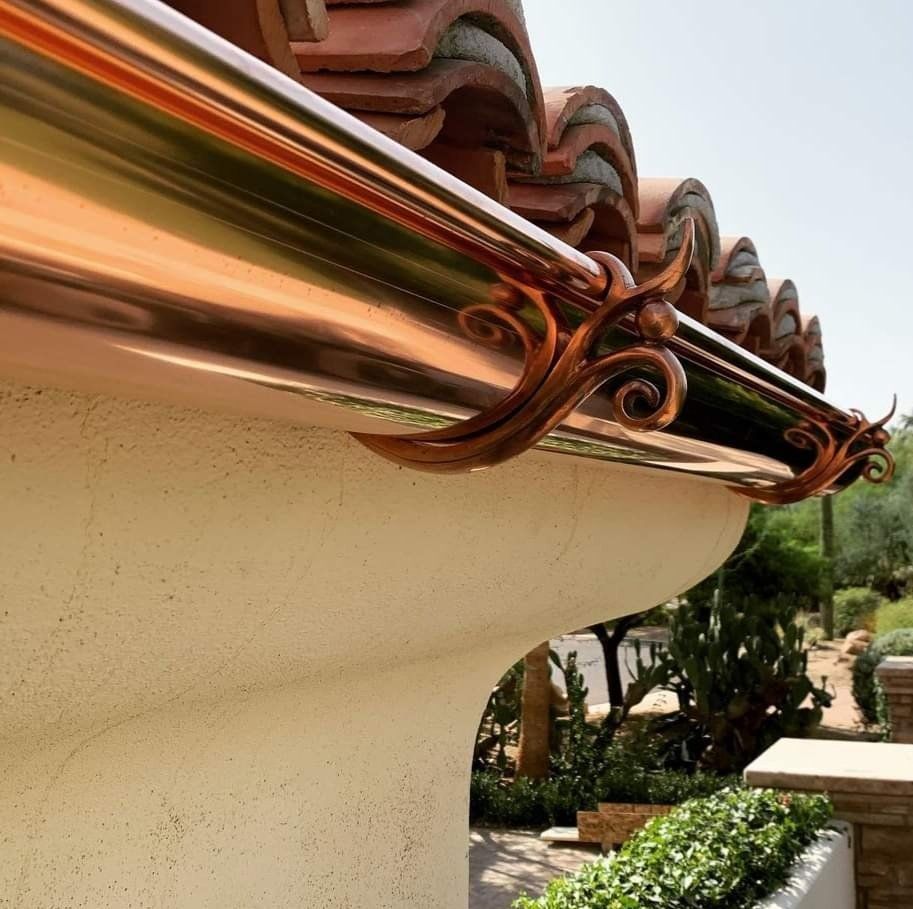
A lot of people assume copper only comes in half-round, but copper K-style gutters are a real option and a good one when you want copper’s look with K-style capacity. They suit homes with crown-molding trim and larger roofs. Copper half-round is still the classic pairing on historic homes, especially with round copper downspouts and decorative brackets.
Either way, copper has to be handled differently from aluminum. Joints are soldered, fasteners and hangers should be copper or a compatible metal, and the color will change over the years as the metal weathers. Our post on how copper gutters age and what they cost to own covers the patina timeline and upkeep.
Box gutters vs K-style
Box gutters are the third common profile, and they come up a lot when people compare gutter styles. A seamless box gutter has a squared, rectangular profile with no decorative curve on the face. It’s popular on modern homes and commercial buildings because it looks clean and carries a lot of water.
Box gutters for houses and small businesses typically run 5 to 6 inches with 2×3-inch downspouts, while 6, 7 and 8-inch box gutters with 3×4-inch downspouts are common on larger roofs and commercial buildings. Custom-fabricated box gutters can be built even bigger for very large roofs. We fabricate all three shapes, and you can compare the sizes and downspout pairings for each gutter profile before you decide. If your home is a modern design with straight lines, a box profile may look better than either K-style or half-round.
How to decide for your home
Start with the house, then check the numbers. A few questions will usually settle it:
- What style is the house? Historic, Victorian and traditional homes usually look best with half-round. Ranch, modern farmhouse and most subdivision homes look best with K-style. Strongly modern homes may suit box gutters.
- How big and steep is the roof? Large or steep roofs shed water fast. K-style or box handles that more easily, or half-round needs to go up a size.
- How many trees are overhead? Heavy leaf fall favors the profile that’s easiest for you to keep clean, or a guard system that fits it.
- What’s the budget? K-style aluminum is usually the most economical. Half-round and copper cost more but can be worth it on the right house.
Material, color and downspout placement matter as much as profile. A well-installed K-style gutter will outperform a poorly installed half-round every time, and the reverse is just as true.
How Gutters Made Easy can help you choose
Gutters Made Easy installs K-style, half-round, box, copper and galvalume gutters across Central Texas, fabricated on site to fit your home. Owner Tyler Smith has more than 20 years of experience with rain gutters and sheet metal, and we’re happy to walk your roofline with you, look at how the water runs and show you samples of each profile. You can compare all of them on our gutter profiles page, or call (512) 881-9204 for a free estimate. Every install is backed by a lifetime manufacturer warranty on materials and a 10-year workmanship guarantee.
Common questions about K-style and half-round gutters
Are half-round gutters more expensive than K-style? Usually, yes. Half-round takes more labor to hang because of the brackets, and the parts cost more. The difference grows if you choose copper or decorative external brackets.
What are common problems with K-style gutters? Debris lodging in the inside corners and water sitting on the flat bottom when the pitch is off. Regular cleaning and a correct slope toward the downspouts prevent both.
Are round gutters better? Not better, just different. Half-round drains more completely and looks more traditional. K-style carries more water for its width and costs less.
When should you use half-round gutters? On historic and traditional homes, with copper, or anywhere the classic look is worth the extra cost. Size them up on large roofs.
Can I switch from K-style to half-round? Yes. It’s a full replacement because the hangers and downspouts are different, and it’s a good time to check the fascia behind the old gutters.