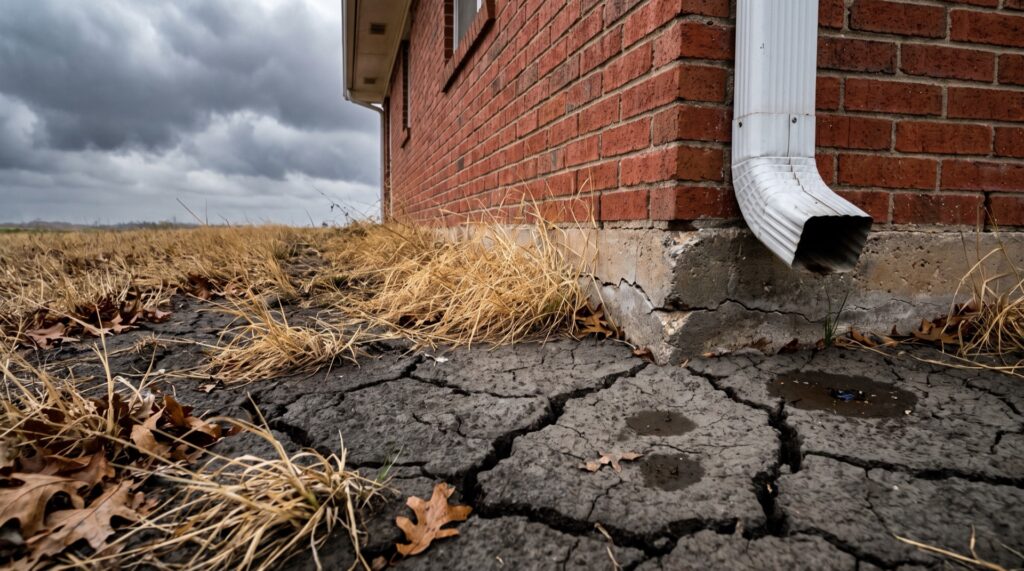
If you’ve lived in Central Texas a while, you’ve probably seen it happen. A long, dry summer, then the first real fall storm, and a week later a door starts sticking or a new crack shows up in the drywall above a window. That isn’t bad luck. It’s the clay under your house reacting to a sudden flood of water after months of drying out, and your gutters have a lot to say about where that water goes. Foundation cracks after a drought usually trace back to the first heavy rain.
Here’s the short version. Gutters can’t stop the soil from moving, but they decide whether the first storm’s roof runoff gets dumped into the dry cracks right beside your slab or carried out where it can soak in slowly. On a Central Texas home, that’s a bigger deal than most people realize.
Why do cracks show up after the first big rain?
Foundation movement after rain in Texas is mostly about uneven moisture around the foundation. During a drought, the soil around the edge of your slab dries and shrinks, while the soil under the middle of the house stays more stable because it’s shaded and covered. When a hard rain finally comes, the dry edge soaks up water fast and swells, but not evenly. One corner gets a flood from a downspout, another corner stays dry under the eaves.
That uneven swelling is what pushes and twists a slab. It’s the difference in moisture, not the rain itself, that does the damage. A house sitting on soil that’s evenly damp all the way around tends to move as a unit. A house with one soaked corner and one dry corner gets pulled in two directions, and that’s when foundation cracks appear.
This is also why the first storm after a drought is the one to watch. A wet spring followed by more rain changes the soil gradually. A bone-dry August followed by a two-inch October afternoon changes it all at once. Soil movement that would have taken a season happens in days, and that’s when most homeowners first notice damage.
What does a dry summer do to the clay under your slab?
Much of the ground east of Austin and through the I-35 corridor is heavy black clay. The USDA’s soil survey describes the Houston Black series, the classic Blackland Prairie clay, as very slowly permeable with high shrink-swell potential. In dry periods it opens cracks half an inch to 4 inches wide that run 12 inches deep or more (USDA NRCS Official Soil Series Description).
Picture what that means beside your foundation. By late summer, there can be a gap between the soil and the edge of the slab, plus a network of cracks running down into the ground. Those openings don’t seal up the moment it rains. For the first hour or so of a storm, they act like funnels. Whatever water lands near them goes straight down, deep and fast, right where your slab’s perimeter beam sits.
Clay that’s “very slowly permeable” also means something once it does get wet. The surface seals over, water stops soaking in, and the rest runs across the yard. So the soil gets a deep, concentrated dose in a few spots and almost nothing in others. That’s the uneven moisture pattern that moves slabs.
East of I-35 vs the Hill Country
Where your house sits makes a difference. The Texas Almanac describes the Blackland Belt as lying just below the line of the Balcones Fault, a band 15 to 70 miles wide, while the escarpment itself runs through Comal, Hays and Travis counties (Texas Almanac). West of that line, on the Edwards Plateau, the almanac calls the surface “a thin, limestone-based soil.”
In practical terms, homes in Kyle, Buda, Lockhart and Pflugerville generally sit on deeper clay that shrinks and swells a lot. Homes out toward Wimberley, Canyon Lake and the hills above San Marcos often sit on a thin layer of soil over rock. There’s less clay there to swell, but in heavy rain the water runs off faster and harder, so the problems tend to show up as erosion and runoff cutting along the foundation rather than big seasonal heave. Plenty of lots right along the escarpment are a mix of both.
Either way, the roof is the biggest single source of water hitting the ground around your house. Soil conditions are what they are. Roof drainage is the part you can control.
Where your roof water lands in that first storm
It’s easy to underestimate how much water comes off a roof. One inch of rain on one square foot is about 0.62 gallons. So a 2,000 square foot roof sheds roughly 1,250 gallons in a one-inch rain, and our fall storms often drop more than that in an afternoon. If you’ve ever wondered why the fall storms are the ones that overwhelm gutters, that volume is the reason.
Gutters collect all of that and send it to a handful of downspouts. That’s a good thing when the downspouts carry it away. It’s a real problem when a downspout ends at the base of the wall, because now you’ve taken water from a whole section of roof and poured it into one spot beside the slab, right into the cracks the summer opened up.
The other trouble spots are where gutters overflow. A clogged run or an undersized gutter sheets water off the front edge in a curtain along the foundation. A sagging section that holds water and then dumps it in one place does the same thing. On a dry clay lot, those spots get soaked while the rest of the perimeter stays dry, which is exactly the pattern you want to avoid.
Signs of foundation movement worth a closer look
Some settling cracks are normal in any house. These are the signs of foundation movement that usually mean the slab is moving enough to deserve a professional opinion:
- Doors that suddenly stick or won’t latch, especially after a storm
- Diagonal cracks in drywall running from the corners of doors and windows
- Stair-step cracks in brick or stone along the mortar lines
- Gaps opening between trim and walls, or around window frames
- Floors that feel newly out of level
If you see these, call a foundation professional or structural engineer to evaluate the slab. That’s not our trade, and we won’t pretend otherwise. What we can do is make sure the water from your roof isn’t part of the cause, so whatever repair you make isn’t working against a downspout every time it rains.
What to fix on the gutters before the next storm
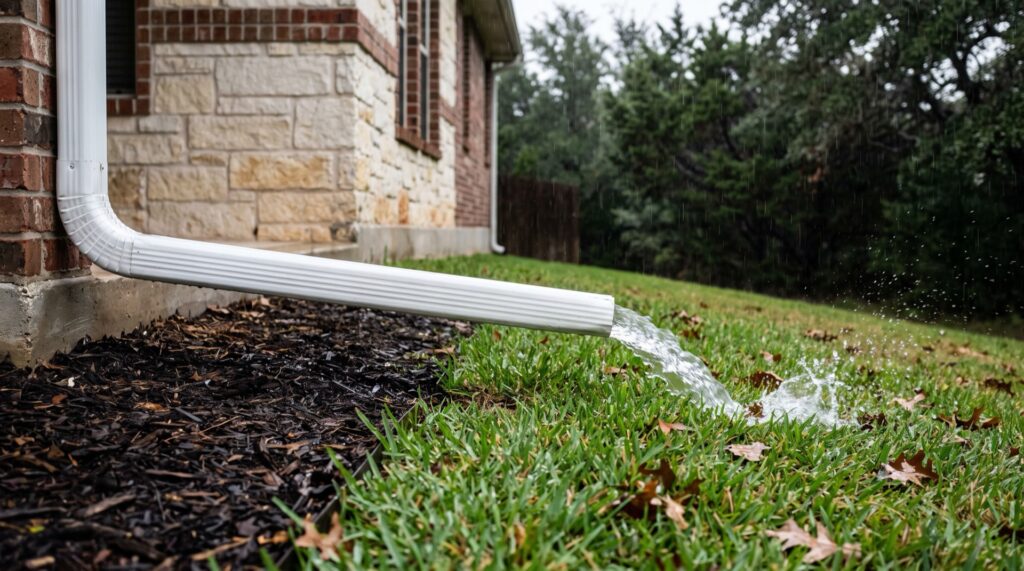
The International Residential Code, which many Texas cities adopt, calls for roof water on expansive soils to be discharged at least 5 feet from foundation walls, or into an approved drainage system (IRC section R801.3). That’s a good target for any Central Texas home on clay, slab or not. Here’s the short list we work through on a house before the fall rains:
- Every downspout discharges at least 5 feet out, onto ground that slopes away
- Splash blocks that have sunk, cracked or turned sideways get reset or replaced
- Long runs with one downspout get a second outlet so they stop overflowing
- Gutters are cleared so the full capacity is there when the storm hits
- Sagging or leaking sections are fixed so they don’t dump water in one spot
On some houses, a simple extension does the job. On others, especially where a downspout lands next to a driveway, patio or flower bed with nowhere to run, a buried downspout line carries the water out to a safe spot underground. And on a roof that has always overflowed in heavy rain, the real fix is a gutter system sized for your roof and Central Texas storms, often with larger 6-inch gutters and more downspouts.
Owner Tyler Smith has more than 20 years in rain gutters and sheet metal, and on a house with this problem the culprit is usually one of three things: a downspout that ends at the wall, a splash block that’s settled and now points back at the house, or a long run that overflows at the same corner every storm. None of those are hard to fix. They’re just easy to miss until the clay reacts and the damage shows up inside.
Can gutters stop foundation movement after rain in Texas?
Not on their own. Central Texas clay shrinks in drought and swells in rain no matter what’s on your roof. What gutters and downspouts can do is keep the roof’s water from landing in a few concentrated spots beside the slab, which is the uneven soaking that turns normal seasonal movement into cracks. Spread the water out and move it away, and the soil around your house stays more even.
So if your house showed new cracks after last fall’s first storm, or you’re heading into October after a dry summer, walk the perimeter now. Look at where every downspout ends and where water pours over the gutter edge. If it’s landing at the foundation, that’s the first thing to change.
Gutters Made Easy is a family-owned company based in Kyle, and we fabricate seamless gutters on site for homes across Central Texas. Our materials carry a lifetime manufacturer warranty, and our workmanship carries a 10-year guarantee. If you’d like a second set of eyes on your downspouts before the next rain, call us at (512) 881-9204 or see how we plan rain gutters and downspouts for Central Texas homes. The estimate is free.