If you own a Hill Country home with wood trim, you probably know the routine. The fascia boards along the roof edge look sharp for a summer or two after they’re painted, then the south and west sides start to chalk, crack and peel. Before long you’re pricing ladders and scrapers again. At some point most homeowners ask the same question: should we keep repainting this wood, or cover it in aluminum and be done with it?
There isn’t one answer for every house. But the choice gets a lot easier once you know why paint fails so fast on fascia here, and which situations still favor a fresh coat. This post walks through that decision. If you want the basics of what a wrap is and how it’s installed, our explainer on how a fascia wrap is bent and installed covers it, so we won’t repeat it here.
Is it better to wrap fascia or repaint it?
For most Central Texas homes, wrapping sound wood fascia in aluminum beats repainting it, especially on two-story walls, on the south and west sides, and on the boards hidden behind gutters. Repainting still makes sense when the wood is sound and holding paint well, when the house needs a painted wood look, or when the trim is easy to reach and you don’t mind the upkeep.
It really comes down to three things: how fast paint fails on your particular house, how hard the fascia is to reach, and how you want the roofline to look in ten years. Let’s take those one at a time.
Why paint gives up early on fascia in Central Texas sun
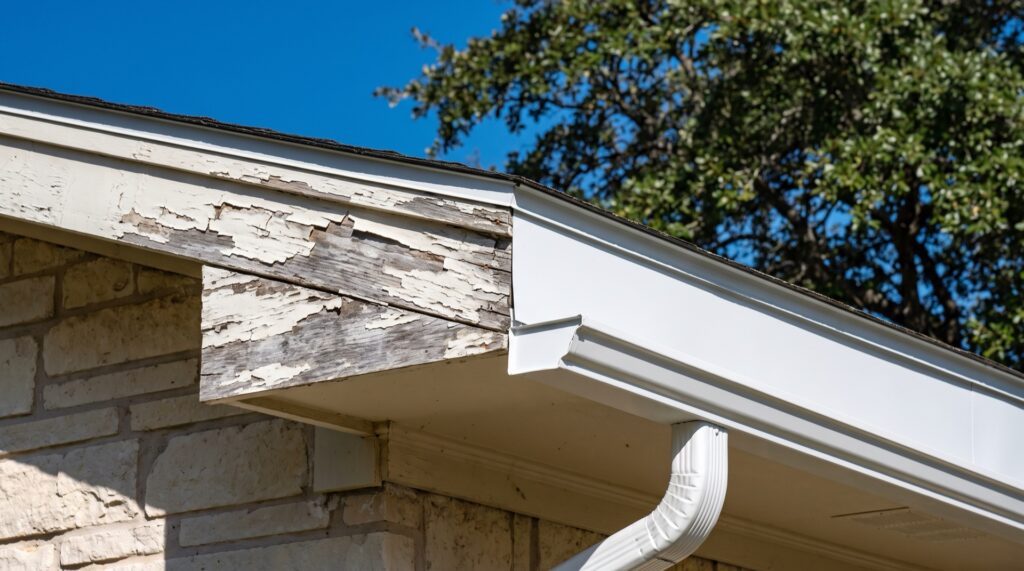
Paint on wood trim has a shorter life than most people think, even in a mild climate. The USDA Forest Products Laboratory’s Wood Handbook estimates that paint on smooth, flat-grain pine, fir or spruce lasts about 6 to 10 years with an ideal three-coat paint job, and roughly half that with only a primer and one top coat (USDA Forest Products Laboratory). Those figures are for an average location in the U.S. Our long, hot summers and strong sun aren’t average.
Sunlight is the main enemy. The same handbook explains that ultraviolet light breaks down lignin, the natural glue that holds wood fibers together at the surface. Once those fibers loosen, paint can’t grip them. In the lab’s tests on cedar boards, wood left in the sun for 16 weeks before painting started peeling within 3 years. Boards painted right away were still in good shape after 20 years. That’s why scraping fascia down to bare wood and leaving it unprimed through a Texas July quietly sabotages the next paint job.
Fascia has two more strikes against it. Much of it is finger-jointed lumber, short pieces glued end to end, and the handbook notes paint on that kind of board tends to fail in a patchwork pattern at the joints. And the fascia is the board your gutters hang on. It gets splashed when a gutter overflows, and painting it properly means working around the gutter or taking it down.
When does repainting wood fascia still make sense?
Wrapping isn’t automatically the right call. There are good reasons to stay with paint:
- The wood is sound and the paint is still holding. If the boards are firm and the old paint is only faded, a wash, light sanding and a quality top coat can buy years.
- You want a painted wood look. Some historic homes, and some HOA guidelines, call for painted wood trim with crisp profiles that a flat metal cover can’t match.
- The trim is easy to reach. On a single-story house with a short fascia, repainting is a manageable weekend job.
- You like changing colors. Paint lets you change the trim color whenever you repaint the house. A wrap’s color is set when it’s bent.
If you stick with painting fascia, give the paint its best chance. The Forest Products Lab suggests a simple tape test: press a strong tape onto the bare or sanded wood and snap it off quickly. If wood fibers come off on the tape, the surface is sunburned and paint will peel. Sand back to fresh wood, then prime the same day and follow with two top coats. Light, sun-friendly colors also help, since the handbook notes dark colors may fade within a few years.
When is an aluminum fascia wrap the better call?
The case for metal gets stronger the harder your fascia is to keep painted. Wrapping tends to win when:
- The house is two stories and every repaint means tall ladders or scaffolding.
- The south and west sides peel first, every time, while the shaded sides look fine.
- The fascia sits behind gutters, where you can’t see trouble starting and can’t paint without working around hangers.
- You’re replacing gutters anyway. With the old gutters off, the boards can be checked, repaired and wrapped before the new gutters go back up.
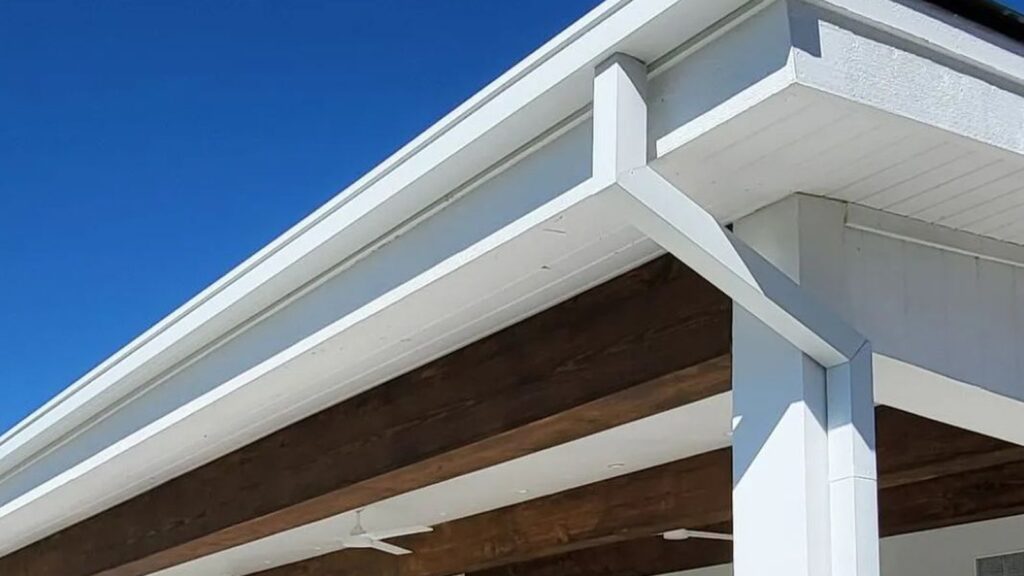
That last point is the easiest time to do it. A pre-finished aluminum cover doesn’t depend on a paint film, so the sun has nothing to sunburn, and it can be ordered in a color that matches the new gutters. If you’re planning new gutters, ask about aluminum fascia wrapping done with new gutters so the boards are covered while everything is open.
Do wraps look better than paint? That’s a matter of taste. A wrap gives a clean, uniform line with no brush marks or peeling, which suits most ranch and modern farmhouse styles. On a detailed older home, a fresh coat of paint on well-milled trim can look more at home.
Wrap or paint, side by side
Here’s the decision in one place. Find the row that best matches your house.
| Your situation | Leaning | Why |
|---|---|---|
| Sound boards, paint only faded, single story | Repaint | Cheap to maintain, easy to reach |
| Peeling again within a few summers on south and west sides | Wrap | Sun is beating the paint film |
| Two-story roofline | Wrap | Every repaint needs tall ladders or scaffolding |
| Historic home or HOA calls for painted wood trim | Repaint | Keeps the original look |
| New gutters going up soon | Wrap | Boards are exposed and easy to cover once |
| Soft or rotted boards | Repair first | Neither paint nor a wrap fixes rot |
Older homes and the lead paint rule
If your house was built before 1978, there’s one more thing to weigh. Old layers of fascia paint may contain lead. Under the EPA’s Renovation, Repair and Painting rule, contractors working on pre-1978 homes must be certified and use lead-safe work practices when a job disturbs more than 20 square feet of exterior painted surface (EPA RRP program). Scraping the fascia on a whole house can easily pass that threshold.
That doesn’t make wrapping exempt. Cutting out a rotted board or prying off old trim still disturbs paint. But a wrap over sound, intact fascia generally involves far less scraping than a full repaint. Either way, if your home is pre-1978, ask whoever does the work whether they’re RRP certified.
What to settle before you choose
Whichever way you lean, check the wood first. A wrap over rotted fascia only hides the problem, and paint won’t stick to soft wood. Press a screwdriver into the boards near gutter corners and downspouts, where water does the most damage. Our guide on how to spot rot in a fascia board covers the signs and what causes them.
If the aluminum wrap is going over existing wood fascia, its top edge has to tuck under the roof’s drip edge so rain can’t run behind the metal. That detail separates a wrap that protects the wood from one that traps water against it.
Next, think about color and the whole roof edge. A wrap and the gutters in front of it read as one line from the street, so most homeowners match them or pick a trim color that works with both. And if you’re wondering about price, the main drivers are linear footage, height, how many corners and returns the roofline has, and how much rotted wood needs replacing first. A two-story house with lots of corners takes more time than a simple single-story run.
Getting fascia and gutters right together
Gutters Made Easy is a family-owned gutter company in Kyle, and fascia wrapping is sheet-metal work, the same trade owner Tyler Smith has practiced for more than 20 years. We bend the aluminum to fit your boards, and when we’re installing new seamless gutters we can check, repair and cover the fascia in the same visit, so the gutters only come down once.
If your trim is peeling again and you’re tired of the ladder routine, or you’re planning new gutters and want the boards protected first, we’re happy to look at the house and give you a straight answer about whether paint or metal makes more sense. You can have your fascia measured for wrapping and get a free estimate, with no pressure either way.