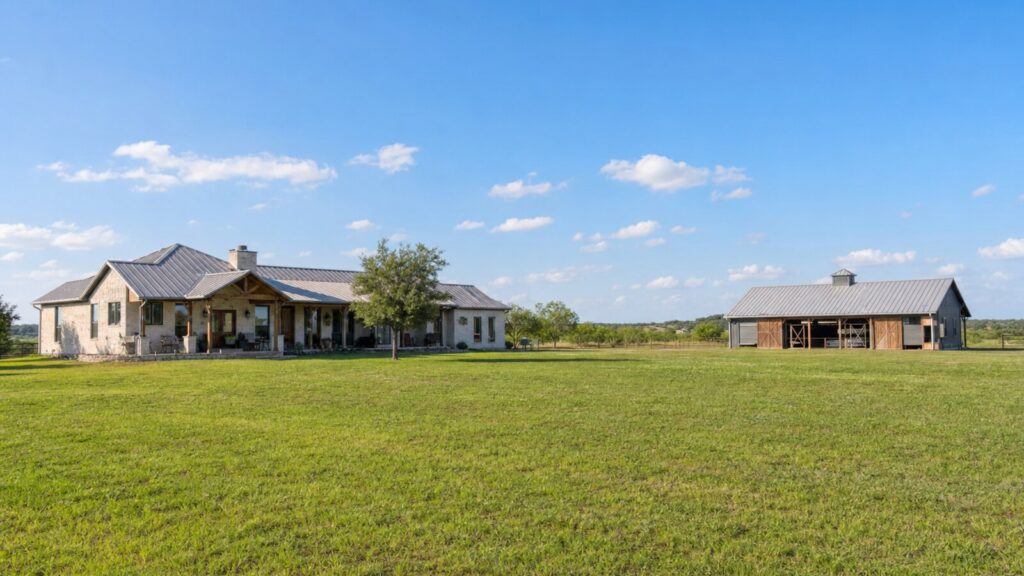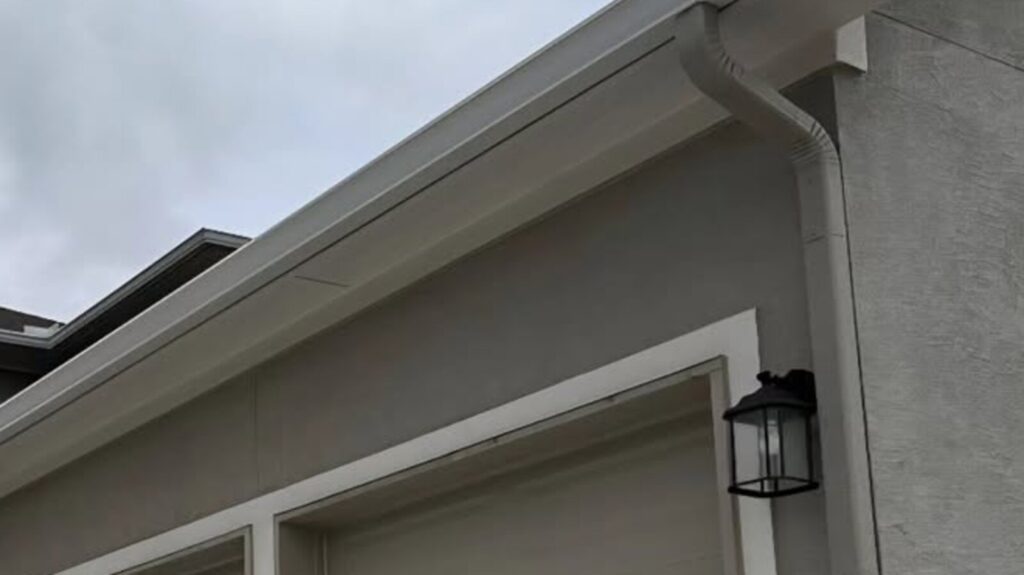

If your new house in Kyle came with gutters over the front door and the garage and nothing else, you’re not alone, and you don’t necessarily need gutters on every edge of the roof. But on Kyle’s clay soil, the sides and back of the house that drain onto your slab, a patio or a narrow side yard usually do. The quickest way to know is to watch where the water goes in the next good rain.
Our office is on Evening Star in Kyle, TX, halfway between Austin and San Marcos, so these are the houses we drive past every day. Here’s why builders stop partway, which missing runs matter most on a Hays County lot, and how to finish the job so it looks like it was always there.
Why do so many new homes in Kyle come with partial gutters?
Kyle has been building homes fast. The U.S. Census Bureau counted 45,697 people in Kyle in 2020, up from 28,016 in 2010 (U.S. Census Bureau). Most of that growth landed in new subdivisions, and a lot of those homes were finished the same way: gutters across the front entry and garage, sometimes a short run over the back patio, and bare eaves everywhere else.
There are a few practical reasons for that. Gutters over the front door keep water off the people walking in and off the driveway, and they’re on the side buyers see first. Builders tend to treat the rest of the gutter system as something the owner can add later. Full gutters add cost to every house in a large build. And building codes generally don’t require a gutter on every edge of a roof. What the International Residential Code does ask for, in areas with expansive soils, is a controlled way to collect roof water and discharge it at least 5 feet from the foundation walls, or into an approved drainage system (IRC section R801.3). How a given house meets that is between the builder and the city inspector. What matters to you is where the water actually lands.
Should a house have gutters all the way around?
Not always. Some houses do fine with partial gutters, and it’s worth being honest about that. A roof edge probably doesn’t need a gutter when:
- The overhang is wide enough that water drops well clear of the wall
- The ground below slopes clearly away from the house for several feet
- There’s nothing underneath to splash, erode or flood, like a walkway, patio or AC unit
- That side of the roof is small, so it doesn’t shed much water
The trouble is that many new Kyle homes don’t meet those conditions on the sides and back. Overhangs on production builds tend to be modest, side yards are narrow, and the back usually has a patio slab right under the eave. If you’ve wondered whether a house needs gutters at all, the honest answer is that it depends on each edge, not the house as a whole. A rain gutter earns its place on any edge where the water has nowhere good to go.
Where do the missing runs matter on Kyle clay?
Much of Kyle, especially east of I-35, sits on the same heavy clay found across this part of Central Texas. The USDA’s description of Houston Black clay, the classic soil of the Blackland Prairie, notes high shrink-swell potential and dry-season cracks half an inch to 4 inches wide that reach a foot or more into the ground (USDA NRCS). Soil like that reacts to water. When one side of a slab gets soaked every storm and another side stays dry, the uneven swelling is what stresses a foundation.
That’s why an unguttered edge isn’t just a cosmetic issue on a Kyle lot. Every storm, the whole roof plane above it drops its water in a line right along the house. These are the spots we pay the most attention to:
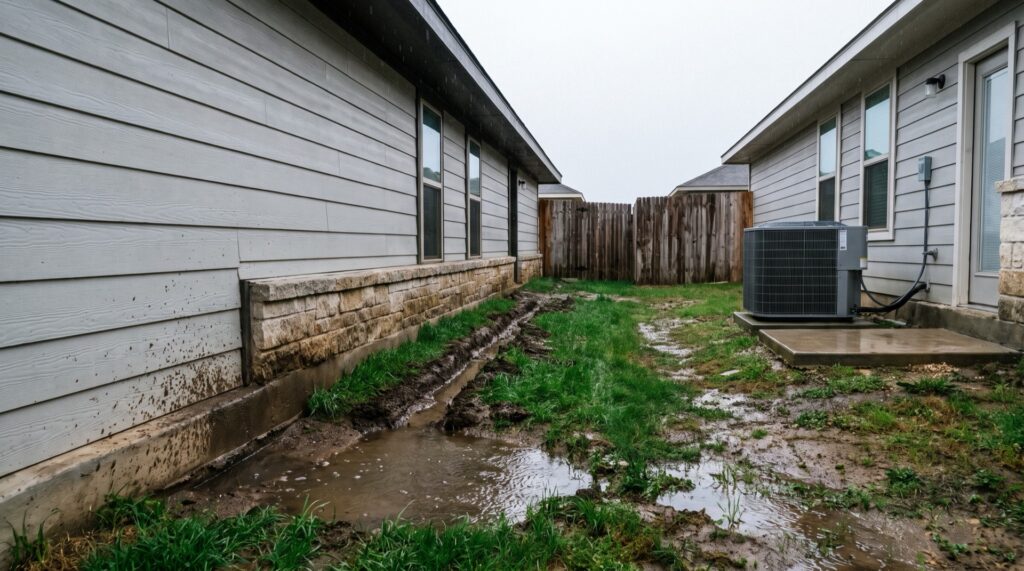
Narrow side yards. In a lot of Kyle subdivisions, two houses sit close together with a strip of grass or rock between them. Without gutters, both roofs dump into that strip, and the water has nowhere to go but along the foundations.
The back patio. Water falling off the eave onto a patio slab splashes back against the wall and runs to the low corner, which is often right where the patio meets the house.
The AC pad and utility side. Roof water pouring onto the condenser and the soil around it washes out the pad over time.
Valleys. Where two roof planes meet, a valley concentrates water from both into one spot. A valley over a bare eave can put out more water than any downspout on the house.
A simple test during the next rain
You don’t need to guess. Put on a rain jacket the next time it really pours and walk around the house, or look closely the day after. These are the signs that a missing run is worth adding:
- A trench or line of bare soil worn into the ground under the eave
- Mud splashed up the brick, stone or siding along the bottom of the wall
- Water standing in a side yard or against the foundation an hour after the rain stops
- Mulch or rock washed out of beds along that side of the house
- Water sheeting off the back eave onto the patio and running toward the house
If you see two or three of these on the same side, that’s the side to finish first. If one side stays clean and dry, it can probably wait. Either way, the point is to move water away from the house on the edges where it’s doing harm.
Finishing the gutter installation so it matches
Adding gutters to a new home should look like the builder did it all along. A good gutter installation on a partial system comes down to a few details.
Match the profile and color. Most builder gutters are K-style. New runs should match the size and profile of what’s already on the front so the lines meet cleanly at the corners, and the color should match too. Many newer subdivisions have HOA exterior guidelines, so it’s worth checking yours if you’re thinking about a different color.
Go seamless. Our seamless gutters are fabricated on site, cut to the exact length of each run, so a side elevation gets one continuous piece instead of sections joined every few feet. Fewer joints means fewer places to leak.
Place the downspouts where the water can leave. A gutter that empties into the same narrow side yard hasn’t solved much. Downspouts should discharge at least 5 feet out onto ground that slopes away. Where there’s no room for that, like a tight side yard or a downspout landing next to a patio, a buried drain line carries the water out to the street side or another safe spot.
Think about the trees you’ll have later. New subdivisions start with small trees, but in ten years those live oaks will drop leaves into your gutters. Planning for gutter guards later is easy to do now.
Check the builder’s runs while you’re at it. On a lot of new builds, the existing front gutters are fine. Sometimes a downspout empties onto the driveway edge and runs back toward the garage, or a seam has started to drip. A small gutter repair or an added downspout on the front is easy to fold into the same visit, so the whole house works as one system instead of two halves.
When it can wait
Not every new homeowner needs to finish the job right away. If you watched a few hard rains and the unguttered sides stay dry, the soil isn’t washing out and nothing is pooling, you can reasonably hold off. Some lots, particularly on the hillier ground toward the west side of Kyle, have better natural slope away from the house. A partial system that’s doing its job is fine. The goal is to fix the edges that are causing a problem, not to sell you gutters you don’t need.
What we’d suggest is not waiting through a second wet season if you already see the signs. Erosion along a foundation only gets worse, and the fall rains are when most of it happens. Homeowners with new builds in nearby towns run into the same question, and our post on new builds in Buda near Onion Creek covers the drainage side in more detail.
Getting it done in Kyle
Gutters Made Easy is a family-owned company based in Kyle, at 457 Evening Star. Owner Tyler Smith has more than 20 years in rain gutters and sheet metal, and our team does seamless gutter work on Kyle homes every week, from finishing partial builder systems to full replacements. Every install is backed by a lifetime manufacturer warranty on materials and our 10-year workmanship guarantee, and financing is available.
If your new home has gutters on only part of the roof and you’re not sure which sides need them, call us at (512) 881-9204 for a free estimate. We’ll walk the house with you, show you where the water is going, and tell you honestly which runs are worth adding. You can also see more about our gutter installs in Kyle, TX before you call.