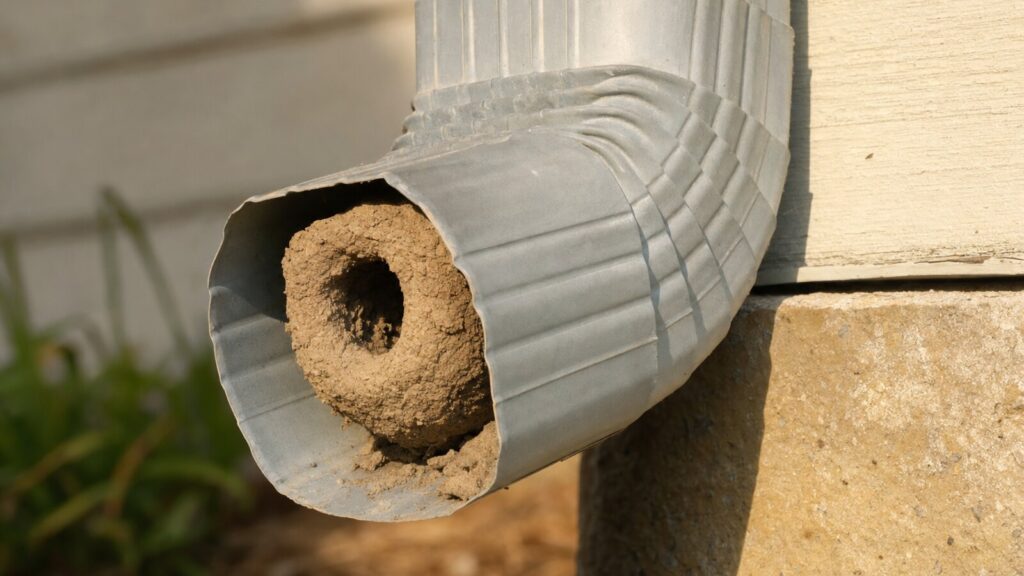
If your gutters drained fine all spring and then one summer storm sent water pouring over the edge, a mud dauber nest in the downspout is a likely suspect. These solitary wasps pack hardened mud into the elbows and turns of a downspout during Central Texas summers, and the plug they leave behind sits there dry and invisible until the next real rain backs water up and over the gutter. It is one of the most common summer blockages we find, and almost nobody sees it coming.
Key takeaways
- Mud daubers build tube-shaped mud nests in sheltered spots, and a downspout elbow is close to ideal for them.
- The nest is usually dry and hidden, so the gutter looks fine until a storm reveals the clog.
- Mud daubers are not aggressive and rarely sting, so clearing a nest is more of a maintenance job than a pest emergency.
- The fix is to clear the downspout and confirm it drains freely, then keep an eye on the same spots each summer.
Why a downspout is prime real estate for a mud dauber
Mud daubers are solitary wasps, which means they do not build big paper colonies like yellowjackets. A single female finds a sheltered, protected surface, then builds a small tube or cluster of tubes out of mud, lays her eggs inside with a paralyzed spider for food, and seals it up. According to Texas A&M AgriLife, mud daubers are among the least aggressive stinging insects in Texas and almost never sting people.
The inside of a downspout checks every box a mud dauber wants. It is shaded, dry between storms, out of the wind, and hidden from birds. The elbow at the top and the bend at the bottom give her a flat, protected surface to work on. Over a Central Texas summer, one downspout can collect several nests, and each hardened tube narrows the channel a little more until water cannot get past.
How the nest turns into a gutter overflow
Here is the sequence we see again and again. The rain slows down in early summer, the downspouts stay dry for weeks, and the mud daubers move in. The mud they use dries rock hard. Then a strong thunderstorm rolls through, the gutters fill fast, and the water hits that plug and has nowhere to go. It backs up the downspout, fills the gutter, and spills over the front edge in a sheet, usually right where you do not want it.
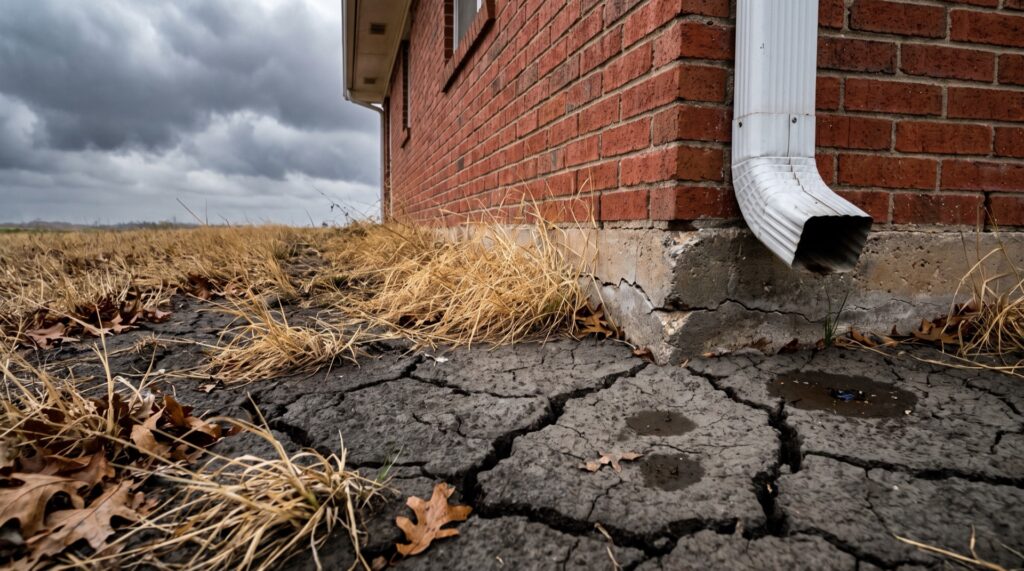
That overflow is not just annoying. Water pouring over the gutter lands hard at the base of the house, and in Central Texas that means it is soaking the soil right against the foundation. On our expansive clay soils, repeated soaking and drying at the foundation is exactly the cycle that leads to movement and cracks. A ten-dollar mud nest can set off a much more expensive problem if it is ignored all season.
Signs you have a nest blocking the flow
You usually cannot see the nest, so watch for the symptoms instead:
- Water sheets over the gutter edge during a storm even though the gutter itself looks clean.
- One downspout stays silent in the rain while the others gurgle and drain.
- You see finished mud tubes on the outside of the downspout, on the fascia, or under the eaves nearby, which means daubers are active in the area.
- The downspout sounds solid instead of hollow when you tap it near the elbow.
If the gutter is clear on top but still overflows, the blockage is almost always down in the downspout, and a mud nest is the usual reason in July and August.
Clearing a mud dauber nest from a downspout
The nest is dry and hard, so a hose alone often will not move it. The reliable approach is to open the downspout, clear the plug by hand or with a plumber’s snake, and flush it. If you can reach the elbow safely, you can loosen the seam or the bottom band, push the hardened mud out, and run water through until it drains fast and clear. Work on a dry day, wear gloves, and never overreach on a ladder.
If the nest is high on a two-story downspout, or you find several of them, this is a good one to hand off. During routine rain gutter repairs and maintenance, we clear the downspouts, check every elbow and outlet, and make sure the whole system drains the way it should before the next storm tests it. We also catch the loose seams or crushed elbows that let daubers get a foothold in the first place. Keeping the gutters themselves clear with regular gutter cleaning helps too, since a clean system is easier to inspect and less inviting to build in.
Keeping them out next summer
You will not stop every wasp, but you can make your downspouts far less attractive and catch nests before they cause trouble:
- Walk the house in early and mid summer and look at every downspout elbow for fresh mud tubes.
- Knock down any new nests while the mud is still soft, before it hardens into a plug.
- Make sure downspout seams and bands are tight so there are fewer sheltered ledges to build on.
- After the first big storm of the season, check that every downspout is actually draining and not backing up.
None of this takes long. A ten-minute walk around the house a couple of times each summer catches most nests before a storm ever finds them.
How Gutters Made Easy handles it
Tyler Smith has spent more than twenty years working on Central Texas gutter systems, and downspout blockages like this are routine for our crew. When we service a system, we do not just look at the top of the gutter. We confirm every downspout runs free from the elbow to the discharge point, because a spotless gutter still overflows if the water has nowhere to go at the bottom.
If a downspout is crushed, poorly sealed, or draining right against your foundation, we will tell you and fix it, and we can re-run or replace downspouts as part of a custom-fit seamless system backed by our lifetime materials warranty and 10-year workmanship guarantee. If a storm just sent water over your gutters for no obvious reason, schedule a gutter repair and maintenance visit and we will find the blockage and get it draining again.
Common questions about mud daubers and downspouts
Are mud daubers dangerous? Not really. They are solitary wasps that rarely sting, and Texas A&M AgriLife lists them among the least aggressive stinging insects in the state. The bigger issue is the blockage their nests create, not the wasp itself.
Why does my gutter overflow when it looks clean? Because the clog is usually down in the downspout, not up in the gutter. A hardened mud nest in the elbow will back water up and over the gutter even when the trough on top is spotless.
Can I just spray the nest with a hose? Often not. Dauber mud dries hard and shrugs off hose pressure. You typically need to open the downspout and clear the plug by hand or with a snake, then flush it.
When are mud daubers most active in Central Texas? Late spring through summer, which lines up with our dry stretch between storms. That is exactly when downspouts sit unused and make easy building sites.
Will gutter guards stop mud daubers? Guards keep leaves out of the gutter trough but do not seal the downspout, so they do not stop daubers from nesting in the elbows. A quick summer downspout check is still the best defense.